The 25-Year Journey of Turkey's First Digital "101" Game
By İhsan Karagülle [Türkçe Versiyon] [Download as PDF] Rev 1.5
In this article, I will share the 25-year odyssey of Hakkarim.net—a project whose foundations were laid in 2001 within my room in a government residence in Hakkari (a remote, mountainous province in Southeastern Turkey). Its name was inspired by the genuine warmth and sincerity of those lands.
 Cover: The Story of the First 101 Game and Hakkarim.net by İhsan Karagülle
I will reveal the behind-the-scenes of this journey, which began as a simple dream of a promotional webpage and transformed into a "digital homeland" bringing millions together. I’ll share every detail that comes to mind—from those early days waiting for a dial-up connection on a black command screen to our high-stakes meetings with Peak Games, and from the growing pains of transitioning to the mobile era to the "Empathy Constitution" we established at the Okey (Rummy-style tile game) tables.
This is not a typical entrepreneurship story because it didn’t start as a "startup" or a business venture. It is the story of how a game, coded entirely out of boredom in my spare time, grew to such a massive scale—perhaps simply because it was the first of its kind.
Meeting Hakkari
In 1999, just before the turn of the millennium, I was appointed to Hakkari. I was a lecturer teaching computer programming at the Hakkari Vocational School, which was part of Yüzüncü Yıl University at the time.
 Hakkari: A city defined by its rugged beauty.
Coming to Hakkari for the first time, I felt the same anxiety that many others did. However, my perspective changed completely upon arrival; I found a beautiful place with incredibly warm people and magnificent nature.
My first project was a simple promotional page hosted on a subdomain called hakkari.guzeldir.com (meaning "Hakkari is beautiful"), designed to guide those visiting the city. In 2001, I officially registered the domain hakkarim.net and expanded the site with comprehensive information, including history, geography, prominent local figures, traditional music, and local cuisine.
"That Cursed Internet"
In those years, internet access was typically provided via dial-up, but since we lived in the university's faculty housing, we were connected through a 1 MBit Frame Relay line tied to Yüzüncü Yıl University. Back then, a 1 MBit speed was incredible—considering the standard was 56K dial-up.
But we had a problem: the university headquarters was in Van, 200km (approx. 125 miles) away from us. Whenever there was a connection issue outside of business hours or on weekends, we had no internet until someone physically went and reset the routers.
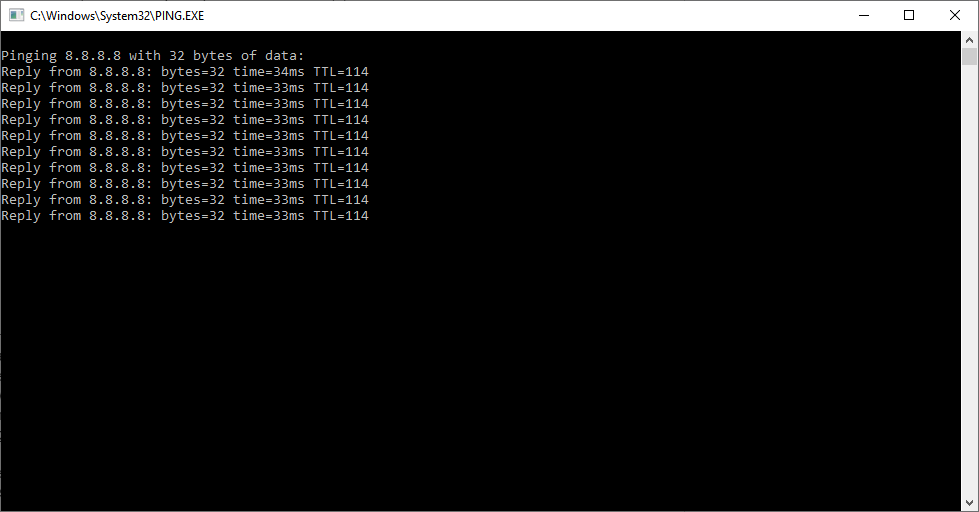
Instead of constantly typing addresses into a browser to see if the connection was back, we would open a command prompt and type ping x.x.x.x -t to ping an IP address and watch the responses. If we saw "Request timed out" repeatedly, it meant we were still offline.
Since these outages could last for hours, waiting in front of the PC became tedious. It was hard to keep an eye on the screen from the couch while watching TV because the small text on a black screen was impossible to read from a distance.
Anyone familiar with computers will recognize that dark command prompt screen I've included below:
The Dark Ping Screen
I described my room to Gemini to have it visualized, and it came up with a very close representation: (Click to enlarge)
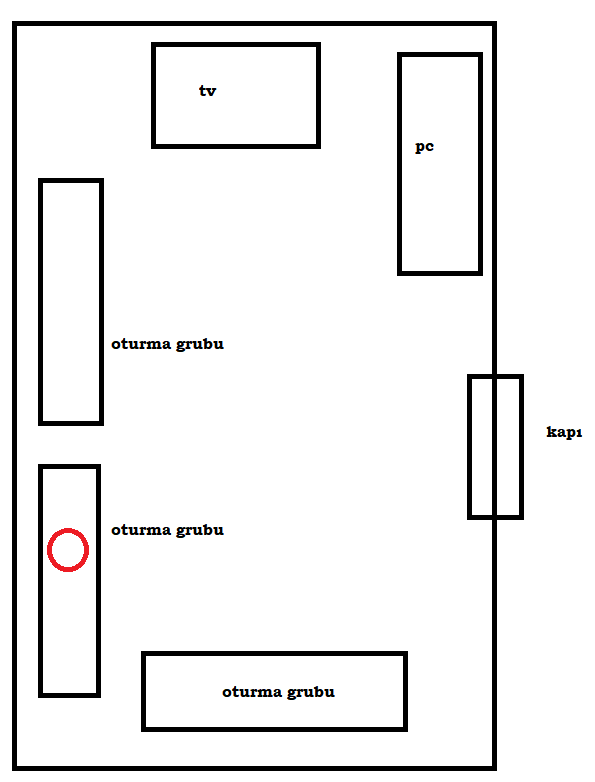
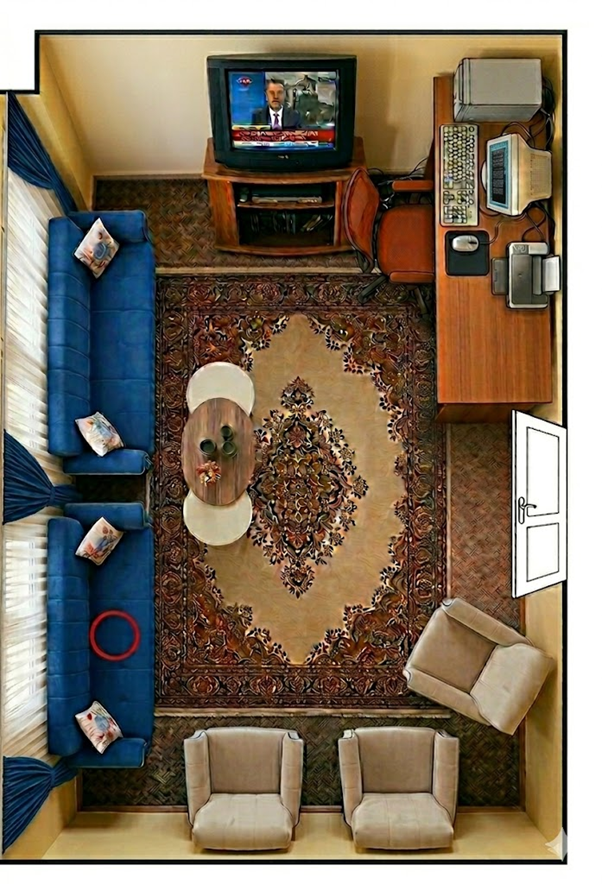
Actually, there were two armchairs, not three, but for some reason, it insisted on drawing three every time, so I didn't push it further.
Pingkontrol.exe
To solve this ping problem, as a programmer, I immediately opened Delphi and wrote a simple application. If there was a connection, it showed a Green bar; if not, a Red bar. This way, I could comfortably keep an eye on the screen while watching TV and jump back to the computer the second the internet returned.
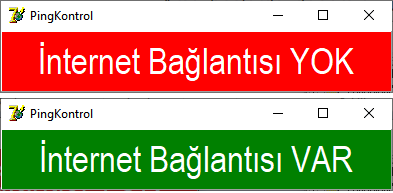 The PingKontrol software interface
The program was named pingkontrol.exe. Knowing that other colleagues living in the faculty housing faced the exact same issue, I mentioned the program to them. They all installed it with great pleasure; thus, the moment the internet was back, we would dive into the network without losing a second. :)
This simple program laid the foundation for ChatWork.exe, which I would write later, and ultimately the 101 game itself. Everything started with the simple curiosity of whether the internet was back or not.
However, these outages were unpredictable. Sometimes, the internet that went out on Friday wouldn't return until Monday. Other times, the issue would be resolved the same day if a bored staff member at the IT department in Van decided to go and reset the routers. This uncertainty was enough to keep us with one eye on the TV and the other on the PC.
Chatwork.exe
As the long outages increased our boredom, I decided to add a simple chat feature to my pingkontrol.exe application to give us a taste of being "online," even if only on our local network.
To avoid dealing with complex server protocols at that stage, I created a simple messaging protocol using UDP Broadcast. I also implemented a broadcast message that broadcasted the list of active participants on the network.
Whichever computer had pingkontrol.exe open would appear in a list by its computer name. This allowed us to be aware of each other’s presence on the network.
I added a chat window and enabled the program to send messages. To account for moments when someone might not be sitting right in front of their PC, I added an alert sound. This way, whenever someone typed something, all "pingkontrol.exe" enthusiasts were notified by a "beep."
In those days, since the internet wasn't as ubiquitous, everyone was accustomed to these kinds of pings and beeps from ICQ and MSN Messenger; that alert sound would instantly spike our dopamine levels. The internet was down, but a "familiar voice" was there. :) During this phase, the name pingkontrol.exe evolved into ChatWork.exe (a shorthand for "Chat on the Network").
I eventually transformed it into a full-fledged Chat Client by adding features like profile pictures. However, what differentiated it from well-known clients was that it operated entirely on the Local Area Network (LAN) without requiring a server (thanks to the broadcast system). (I later uploaded it to the internet for anyone who needed it; a 5-star hotel in Antalya, Hotel Turquoise, even asked for a custom version, which I developed for them for free. I'm not sure how long they used it).
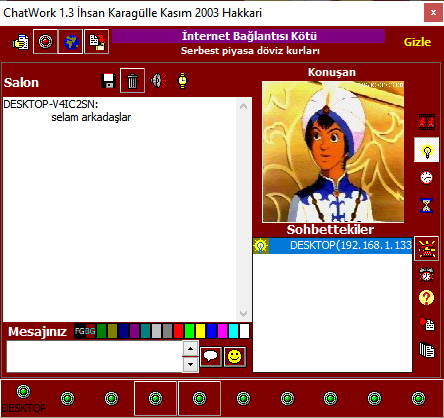 The Chatwork program running on the Local Network (LAN)
Initially, that familiar beep provided a dopamine boost, but over time, as chats started stretching into the early morning hours, it began to get annoying.
When those who only wanted to check if the internet was back started getting disturbed by the constant "beeping" of two people chatting, I added a Private Chat feature. This allowed everyone running ChatWork.exe to join the general conversation (public chat) while also enabling two people to message each other privately until dawn without bothering the rest of the group.
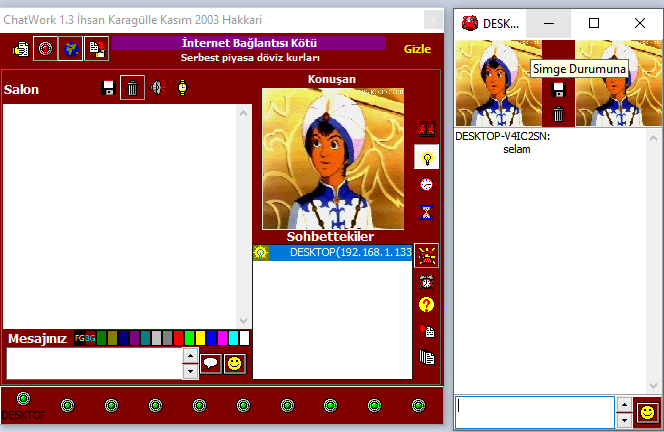 Chatwork program featuring the Private Messaging module
The public and private chat modules still found in the Hakkarim.net 101 game today have their roots in those early years.
A World First: Coding the "101"
Meanwhile, "Okey"—the national board game of Turkey—was played in a very specific way in Hakkari. In those years, Classic Okey (Rummy-style tile game) could be played online, but the 34/101 variation (a more complex, strategic version) played in Hakkari was not available on any website. I began receiving frequent requests from the locals:
"Teacher, you should write the code for this game."
In those days, screen resolutions were so low—typically 800x600 pixels—that fitting the complex UI of a 101 game (where players must lay down multiple sets of tiles on the table) was nearly impossible. While 1024x768 resolution existed, it wasn't yet the standard. Despite its rarity, I started brainstorming a design that would function at 1024x768.
"1024x768 resolution is just enough for the 101 game."
The Vocational School was built on a hill in Hakkari, and when the heavy snow hit, there were times we couldn't descend into the city for an entire week. This meant I had plenty of time on my hands, and I had already built the chat infrastructure within ChatWork.exe.
Furthermore, I had already launched the hakkarim.net site for promoting the city, which included a networking/socializing section. Users could create profiles and leave messages on each other’s pages. In other words, I already had a membership database—but the game itself didn't exist yet.
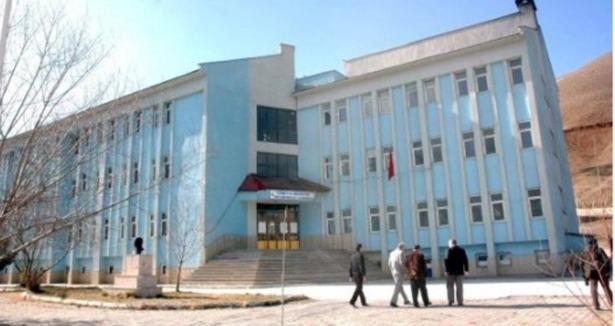 The Hakkari Vocational School: My high-altitude development lab.
Long Winter Nights and the First 101 Program
During one of those long and harsh winter nights, I began thinking about coding this game. My initial goal was simple: to create a game we could play with my colleagues in the faculty housing over our local network.
The first time I uploaded the game to the internet was May 2005. This means I likely started coding around January or February. This project also holds the title of being the first-ever programmed version of the 101 game in the world. You can see the first example in this archive.org record from May 27, 2005: archive.org link
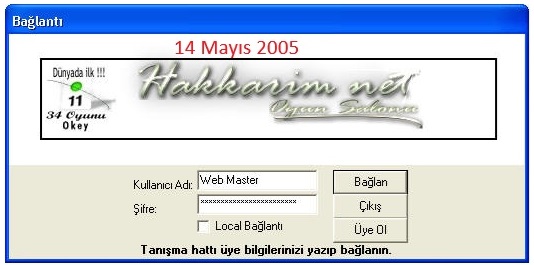 The world's first-ever 101 game software.
While the Broadcast-based UDP protocol worked fine for the serverless ChatWork, introducing game logic required a server software. Thus, I moved away from the UDP broadcast logic and began coding a server application using the TCP protocol.
This server ran on the PC in my room. Thanks to Remote Desktop, I could connect from my home in the faculty housing to my office at the school and update the code on the fly.
Since the housing and the school were on the same network, I developed the game to connect to my Local IP address and began sending copies to my colleagues who were eagerly waiting to test it.
At that stage, I wasn't even thinking about putting it on the internet. My only goal was to have a good time with my friends in the housing complex when the internet was down.
However, finding 4 players was surprisingly difficult. It was a small school, a 20-apartment housing complex, and in those years, PC ownership was not common. Only about 6 or 7 of us had PCs, and getting four of them online at the same time was a challenge.
In the meantime, the locals who had previously said, "Teacher, you should write this game," heard about the project and wanted to join. So, I updated the server to allow connections from external IPs as well.
Users of the very first version might remember a specific option in the connection window called "Local Connection" (Yerel Bağlantı). Those connecting from the faculty housing had to select this because Internal and External IPs were different.
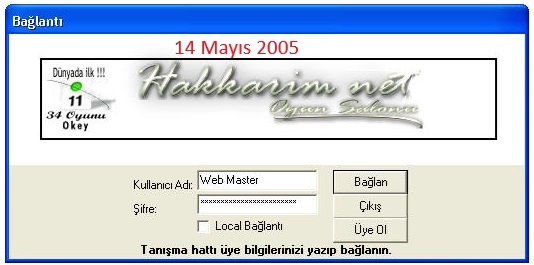 The "Local Connection" feature.
Archive.org link for this first screenshot: Archive.org
Actually, this resolution story and the Peak Games situation I’ll mention later highlight just how crucial timing is in software development.
Having been in the PC era since 1989, I witnessed the evolution from 320x200 to 640x480, and then to 800x600 and 1024x768. Had such an application been made during the 320x200 era of the 1990s, the chance of success would have been extremely low due to inefficient screen real estate.
Even though screen sizes technically "shrank" when we entered the mobile era in the 2010s, the touchscreen experience made it far more viable than the 1980s or 90s.
2005 was exactly the year when 1024x768 resolution started becoming widespread, providing enough space for games like 101 that require laying down multiple sets of tiles. If we had launched this 5 years earlier during the 640x480 era, the user experience wouldn't have been nearly as good.
While 1024x768 resolution freed us on the PC, it actually made it harder for us to adapt to the mobile era that began in 2010.
Here is the first view of our game lobby in 2005:
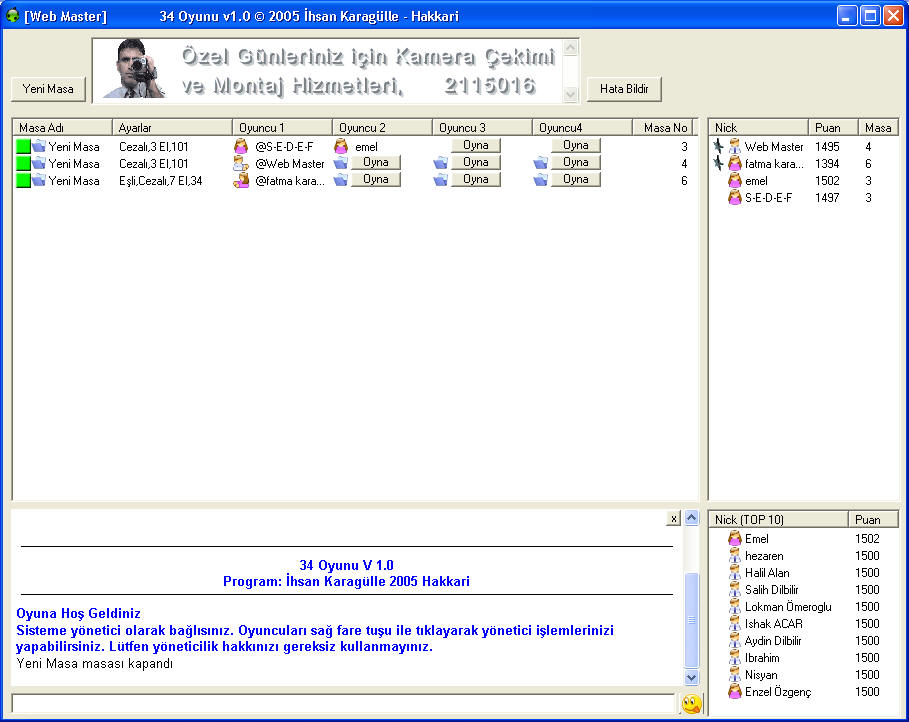 Our first lobby view from 2005:
Archive.org link for this first lobby view: Archive.org
The program is so new that in a game where everyone starts with 1500 points, the highest score is only 1502! :)
And here is the first view of a game table from 2005:
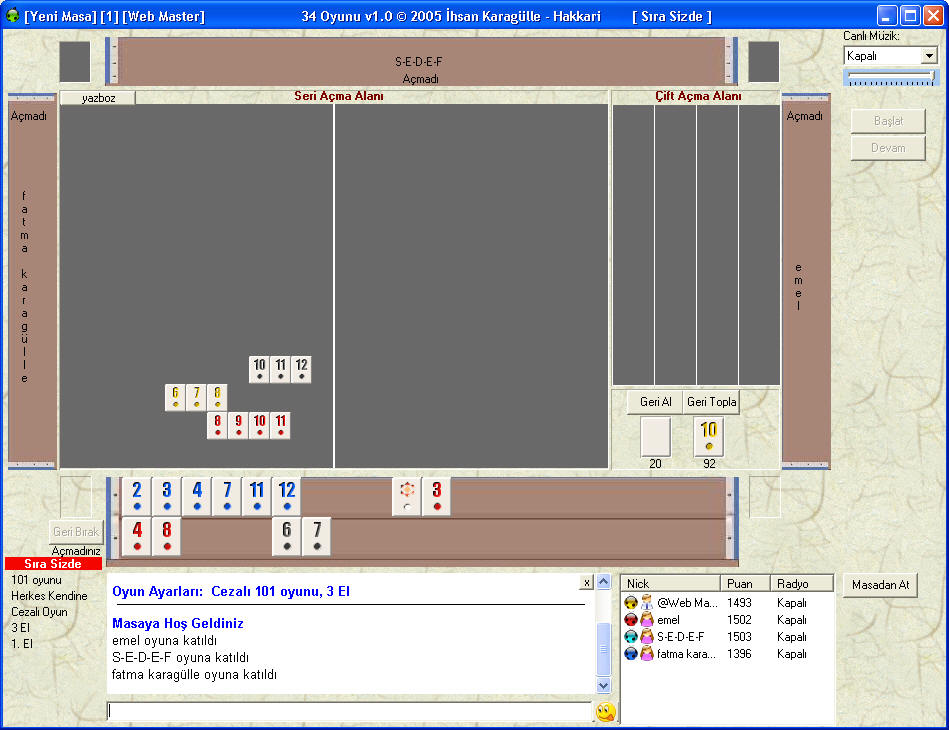 Our first game table view from 2005:
Archive.org link for this first table view: Archive.org
Izmir, Beautiful Izmir
Since I already had a website dedicated to promoting Hakkari, I integrated the game's membership infrastructure into the existing social networking section of the site and added a download link. I updated the program to allow external connections, and we sat down for a test session at an internet cafe in Hakkari with three curious locals.
As the four of us opened a table and started playing, something incredible happened:
Someone other than us connected to the lobby. We were speechless. A woman who had created a profile from Izmir (a major city on the opposite end of Turkey) entered the room. For a moment, we didn't know how to react; she opened a table for herself, stayed for a while, and then left without saying a word.
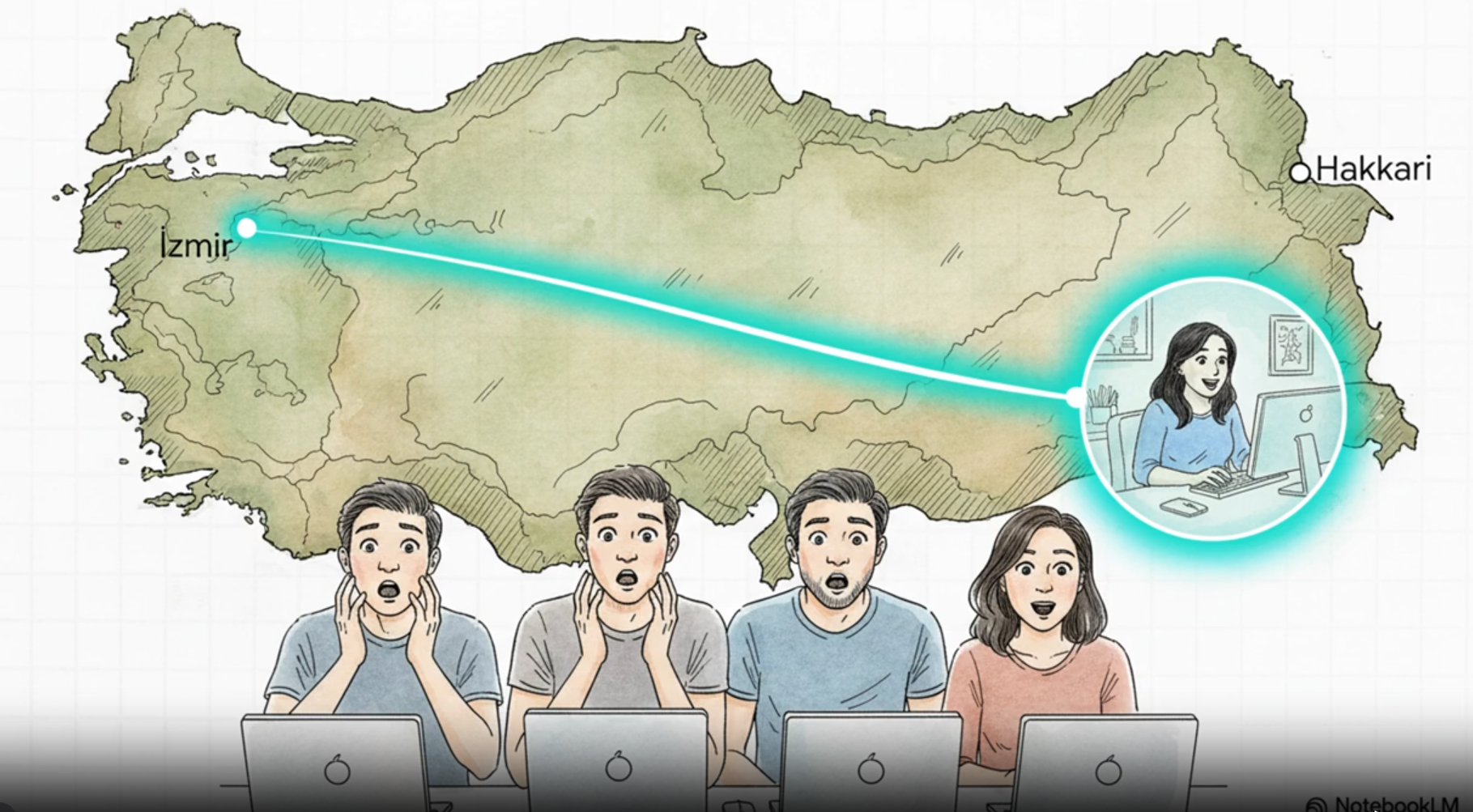 Our first player to enter the country is from Izmir, on the other side of the country.
Strictly speaking, we knew that someone could theoretically download the game, register, and connect—but seeing a stranger actually download the executable and log in was still shocking. (In those years, downloading an EXE file to a computer was an act of courage. Today, we ensure the integrity and trust of our files with a Microsoft Extended Validation (EV) Code Signing certificate, a security standard held by very few companies in Turkey).
Our First Members and Emerging Issues...
The program, which I initially wrote focusing solely on game mechanics, brought a management crisis to the forefront as the number of users grew. Problems like inappropriate chat behavior and "rage-quitting" (leaving the game upon losing) forced me to start adding administrative modules to the software.
Today, it is likely that 10% of the code is the game itself, while 90% is management infrastructure. This administrative side became so vital that we soon realized we even needed to manage the management.
10% game, 90% management
And so began our never-ending meetings. On one hand, there was incredible interest—people from all over the country were downloading the app and joining the games. On the other hand, I started releasing daily updates to solve the problems caused by disruptive members.
First, I defined administrator privileges (mod powers) so we could take action against problematic users.
Double Trouble (2x Problems)
After a while, I was introduced to the concept of the "problematic administrator."
When someone I granted authority to solve member issues turned out to be problematic themselves, abusing that power created an environment much worse than having no authority at all.
At first, we tried to resolve these issues by talking and holding meetings, but as the number of admins grew, internal friction and infighting began. Again, I tried to fix it manually and eventually selected a few as "Referee Administrators." Normally, that referee was me; however, I didn't want to spend my time dealing with petty disputes while also trying to update the code. I delegated admin-related problems to three Referee Administrators and finally breathed a sigh of relief for a while.
Meanwhile, the community was growing rapidly, and people from all over the country began organizing tours and trips to Hakkari to see the roots of the game.
The Picnic
The game I launched in May had grown so rapidly that by July, we were meeting in Hakkari for the second time with a group of players and administrators. We went for a picnic in a valley where a beautiful stream flows between two mountains—the name of which I can't recall—after crossing a suspension bridge over the Zap River, feeling like Indiana Jones.
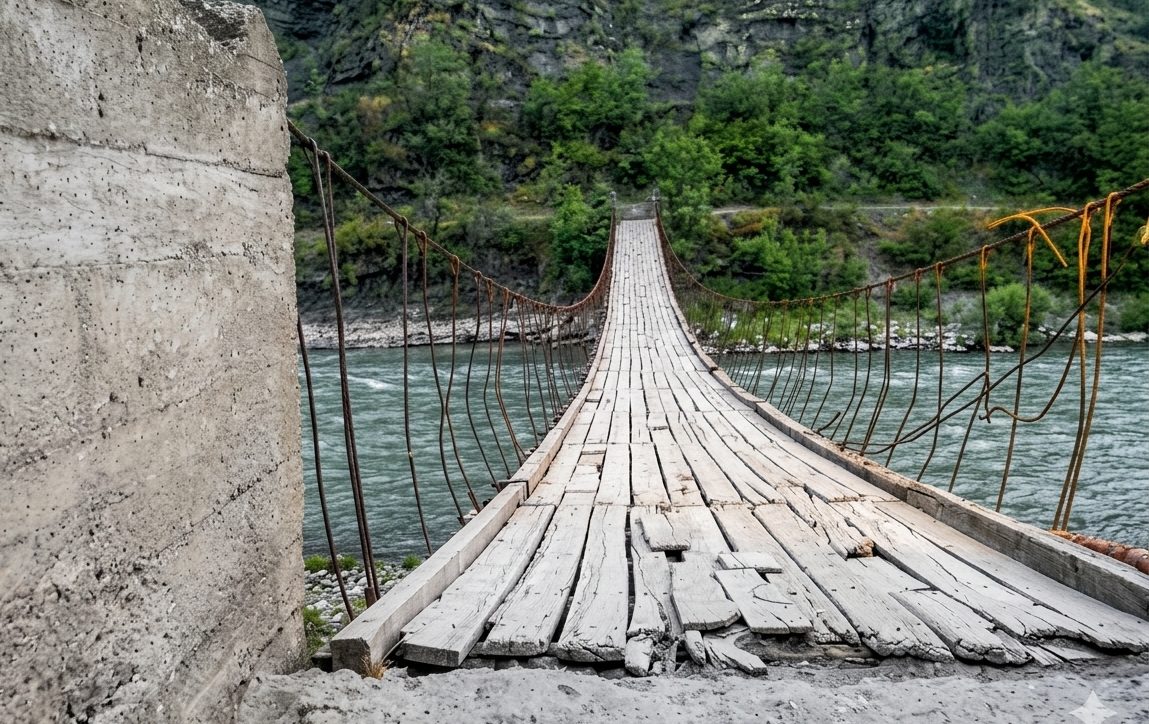 The suspension bridge over the Zap River, reminiscent of an Indiana Jones film.
When we returned that evening: Tadaaaaa! The game had frozen. No one could log in. I reset the system and got it running again, but I was left with one nagging question: Why did it freeze?
Lobby 2
As the user base began to multiply, we reached about 150 simultaneous online players. I realized I needed to segment the crowd, so I introduced the "Lobby" (Salon) system commonly seen on other gaming sites. Instead of grouping everyone in a single space, I created Lobby 1 and Lobby 2, each with a 100-person capacity. Once a lobby reached 100 players, it would trigger a "Lobby Full" message, prompting users to join the other one.
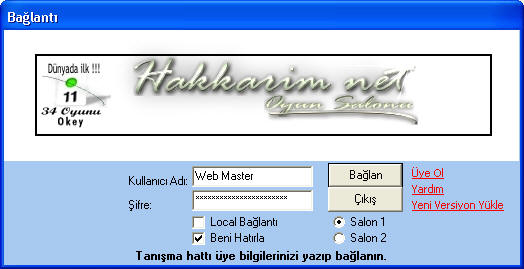 Lobby 1 and Lobby 2
To implement this with minimal effort, I simply ran a second copy of the server program, named it yuzbirserver2.exe, and configured it to run on a different port. This way, the second instance of the game started running smoothly.
However, that cursed freezing issue kept occurring sporadically. Every 3 or 4 days, the program would strangely lock up. What’s more, while one instance remained active, the other would freeze. If it were a network-wide issue, both should have crashed; instead, one would freeze at completely random intervals.
The hardest bugs to diagnose are those random freezes that occur on a live system.
In addition to managing user and administrator conflicts, I was now desperately trying to understand the root cause of these freezes.
Lobbies 3, 4, 5...
The site was growing rapidly, and Lobby 2 soon became insufficient. As we expanded to 3, 4, and eventually Lobby 5, a new problem emerged. With every new lobby we opened, we were forced to recruit more administrators to intervene if any issues arose during gameplay. Meanwhile, the demand to become an admin was so high that it started causing friction and hurt feelings within our close social circles—but that wasn't the main problem:
Everybody wanted to be in Lobby 1.
Because it was the "premier" lobby; it was the first to fill up, and that’s where all the familiar faces were.
Being an admin in Lobby 1 was a status symbol, but Lobby 2 needed management just as much.
This situation turned into a full-blown crisis by the time Lobby 5 opened.
The game had been live for 8 months now. We had dozens of admins, and we had appointed our three best as "Referee Administrators" to decide on new recruitments and handle disciplinary actions for those not performing their duties.
But nobody wanted to stay in Lobby 5. The admins there started getting grumpy with the players; they realized that if no players came to Lobby 5, they could justify heading over to Lobby 1 to join the popular crowd. As a result, they actually started treating players in Lobby 5 poorly to drive them away.
Advertisements
Let's take a short break here to talk about how we managed the expenses for all these players.
As the player count surged, I rented a dedicated server and migrated the server software there.
Naturally, our first thought for revenue was advertising, like everyone else. We even managed to find a few ads.
But can you really "keep the mill running with hauled water"? To be honest, we weren't even worried about the mill; this was a purely amateur project, and we had no real concern for making money.
If it covered the server costs, that was enough. One of our administrators from Istanbul (khoc) was working feverishly on ad negotiations. He was even talking to Turkish Airlines :) but in the end, he managed to convince a relative from Van to place an ad instead. :)
I think we took ads maybe twice. Later, because of the "full lobby" issue, we decided to introduce a "Gold Membership" model (November 2005).
Those who insisted on being in Lobby 1 could purchase a Gold Membership—which was about 11 TL (~$7-8) per month at the time—and enter any lobby they wanted, regardless of whether it was full or not.
We activated the Gold Membership model six months after the game’s launch. It wasn’t exactly "wildly popular" at first, but it certainly helped cover the expenses.
When our first Gold Member transferred 11 TL (~$7-8), the amount was small, but it brought back that same joy I felt when that user from Izmir first trusted us enough to download our EXE file.
Wow—they actually thought it was worth paying for. Six months after the game opened, we had brought our first paid feature to life.
Being deemed "worth paying for" is a deeply motivating feeling for a programmer.
Advertising is such a poor revenue model; it frustrates both the player and the programmer. After those first two ad attempts, we completely removed the advertising model from the game. It wasn't worth bothering the players for a few pennies.
Today, we are one of the few mobile games that remain entirely ad-free.
Ads = A poor revenue model that only serves to annoy the user.
This Is a Technical Problem
Taking a "break within a break" (much like a story within a story from Kalila and Dimna), let’s return to the freezing issue.
Under normal conditions, the TCP protocol cannot always detect if a connection has been lost. That’s why you design a Heartbeat (Ping) protocol: you send a message (Ping) to the server at specific intervals and check for a response. If a reply comes back, you know the connection is active.
But occasionally, something occurs that is so rare it makes diagnosing the issue extremely difficult.
Your messages reach the server, but the server’s messages never reach you. The server fails to deliver its response, yet because it continues to receive messages from you, it assumes you are "alive" and refuses to terminate the connection.
Those undelivered messages start to pile up on the server side. They keep accumulating until they completely fill the buffer space Windows has allocated for that specific connection. Once that space is full, Windows refuses to accept any more outgoing messages. The entire message-handling process for that thread freezes until those messages can be delivered and the space is cleared.
To prevent this, you need a PONG protocol (a two-way handshake), and you must also increase the buffer limits Windows assigns to each connection as much as possible to mitigate these issues.
I added both to the software, but it took about a month to pinpoint the cause. This was because the problem had to be tested in a live environment—since it’s triggered by a user with a specific connection issue—making it impossible to replicate in isolated tests. Furthermore, the issue was at the Operating System level rather than the application level (technically, it's not a bug but a standard behavior of the protocol), which made detection quite tedious.
Anyone who has spent time in online games might have encountered this: one player can see what everyone else is writing, but no one can see what they are writing. This happens because the server can receive their messages but cannot send any back to them.
If you don't disconnect a player experiencing this specific problem within a certain timeframe, the stack region allocated to them will overflow, causing all message transmissions to grind to a halt.
Back to Lobby 5
Perhaps if Lobby 5 hadn't existed, and if those grumpy administrators hadn't behaved the way they did, Hakkarim.net would never have grown this large.
From the very first day the game went live, there was a management challenge.
Writing the code wasn't enough; managing this massive crowd was the real task.
When the 16-year-old son of the Vocational School Director and the local Police Chief sat at the same virtual table, even a simple slang word or a slight bit of informal language was enough to tense up the atmosphere. It led to complaints like, "Teacher, what is this? Why are you letting kids in here?"
We tried to balance these sensitive social dynamics through endless management meetings, deciding which words were forbidden, which were acceptable, and so on.
However, the "grumpy administrator" issue was a serious problem. As the number of lobbies increased, we had to assign at least 5 to 10 admins to each lobby to ensure at least one was online at any given time during a 24-hour cycle.
The syndrome that led us to discover a new business model: The Grumpy Administrator Syndrome.
The First Lobby Rental
While discussing this issue in a meeting with the administrators, I made a decision: "This isn't working. I’m going to rent out Lobby 5."
Although they protested, saying, "Teacher, that’s impossible! If someone pays, they’ll think they can do whatever they want; it’ll never work," I didn't listen. In February 2006, nine months after the game launched, I rented out Lobby 5 for the first time.
Our first tenant was a major car dealership owner from Van.
And once again, something incredible happened. Our tenant, who was paying a monthly rent of 150 TL (~$100), started welcoming players to the lobby with "Welcome" messages and virtual flowers. He even asked, "Teacher, I want to make my lobby 'Gold' so everyone who enters becomes a Gold member," which led me to program a new feature: Lobby Gold (100 TL (~$65) /month ).
Instead of our own admins saying, "What are you doing here? Get out so we can go play in Lobby 1," we now had a management model where the host welcomed everyone, gifted them Gold status, organized tournaments, and paid us a monthly rent on top of it all.
"I’m paying for it, so it shouldn't stay empty."
In this model, because the person renting the lobby was paying a fee, they actively worked to ensure the lobby stayed busy. They focused on player satisfaction to convince users to choose their lobby over Lobby 1.
They took over the management burden at a micro-level, and frankly, they did a better job than we ever could. If we hadn't solved the management problem this way, I don't think we could have grown.
The "Lobby Rental" model became a blueprint for all gaming sites.
This model became so successful that eventually, all gaming sites adopted it. For instance, Mynet—a massive gaming portal at the time—was clearly struggling with this issue. Because they couldn't manage the crowds, they had to shut down public chat and restrict it to Gold members only. However, on our platform, "Public Chat" was exactly that: a place for conversation that could not be closed unless absolutely necessary.
Eventually, Mynet also switched to the lobby rental model, but the difference in execution was stark. In our system, even if you own the lobby, you cannot ban a player without a valid reason; if you do, we shut down your lobby. Meanwhile, Mynet listed "The power to ban whoever you want" as a benefit of renting a lobby. :) (As of April 15, 2026, they still do.)
Lobbies, Lobbies Everywhere
This lobby rental method left everyone speechless; frankly, even I hadn't anticipated it would work this well. Soon, people were lining up to rent our remaining Lobbies 4, 3, and 2. Eventually, we rented out all of them except for Lobby 1. We realized they were managing the rooms much better than we were—at least in terms of hospitality. They treated players exceptionally well and organized activities to ensure they’d return.
Lobby 1 remained as our "flagship." It served as the model room, demonstrating to other lobby owners exactly how the administrative rules should be applied, and functioned essentially as our management headquarters. It stayed that way for a long time.
As the number of lobbies multiplied, so did the friction between them.
When I first rented out Lobby 5, I had added an Admin feature. I granted the tenant the right to appoint two Administrators, and they could recruit their own moderators. Later on, even having just two admins started causing headaches. Interestingly, after a system overhaul, a situation that was problematic with only two admins ceased to be an issue even with 125 admins. Perhaps I’ll explain how that "scaling miracle" happened in the upcoming sections.
Inspectors, Coordinators, and Authorities
As friction between lobbies began to surface, we introduced two new tiers to our management structure: Inspectors (Denetleyici) and Coordinators (Koordinatör).
If an administrator treated a player unfairly, an Inspector—acting on behalf of the site—would review the complaint. If the admin was found to be in the wrong, the Inspector would revoke the action and, if necessary, penalize the admin.
Coordinators, on the other hand, handled complaints regarding the Lobby Admins themselves and resolved disputes between different lobbies. At the very top of this pyramid were the Authorities (Yetkili), who acted as the final court of appeal if an issue couldn't be resolved at lower levels or if a decision was contested.
We structured our management hierarchy as follows:
- Lobby 1: The "Flagship" lobby and its primary staff.
- Inspectors: The first line of oversight.
- Coordinators: Strategic management and inter-lobby mediation.
- Authorities: Senior leadership and final decision-makers.
We began selecting our Inspectors from long-standing members of Lobby 1 who had mastered the system and demonstrated a high standard of conduct.
As Inspectors gained expertise, we opened a career path for them to be promoted to Coordinator or Authority.
Since Inspectors were often newer to the role, we preferred Coordinators to handle disputes between Admins. Having served in management for longer periods, they were better equipped to make sound, balanced decisions in complex situations.
Complaints, Oh the Complaints!
As I’ve said, writing the game wasn’t enough; managing user complaints was equally vital. Other gaming sites at the time operated on the "send us a screenshot and we'll take action" logic, but I saw the fundamental flaw in that system:
Anyone with even a basic understanding of computers could fake a screenshot, making it look like someone else was insulting them when they were actually the instigator. They tried this many times to get innocent people banned.
I solved this problem by introducing Digital Signatures and the "Report" (Ş) button.
By clicking the "Ş" button (shorthand for *Şikayet* / Complaint) in the chat window, you could send the last 10 lines of dialogue directly to an administrator. If the issue required more context, you could hit the "K" button (*Kaydet* / Record) to save the entire conversation.
The system would digitally sign this conversation file and allow you to save it to your computer.
Even if a user opened that file and tried to modify the text, the digital signature would become invalid. Our administrators used a tool called imzakontrol.exe (Signature Checker) to instantly detect forged logs and prevent fraudulent reports.
Today, this process is fully automated. Users no longer need to manually verify files; they simply click "Upload for Review," and the system automatically audits the digital signature to detect any tampering.
This integrity-check system kept the "lamers" (troublemakers with basic PC skills) away from the community.
When a program grows this large and its audience expands so broadly, it inevitably becomes a target for hackers—or let’s just call them "curious programmers."
When you press the "K" button, the program records and signs the chat. However, anyone familiar with development knows you can use memory editors to change the text on your screen. If the screen displays altered text when you hit record, the program would theoretically sign that corrupted data.
To prevent forged signatures via memory manipulation, I implemented a system to block unauthorized access to the program's memory (I won’t reveal exactly how I achieved that).
This ensured that even if someone modified the text on their screen using a memory editor, the system would detect the interference and refuse to sign the fake conversation or allow it to be sent to an admin via the "Ş" button.
When a Programmer Becomes a Player
Years and years ago, long before hakkarim.net existed, I was playing Okey on another site and got curious enough to sniff the game traffic. (Sniffing refers to a method that allows us to monitor and intercept all data flowing through a network).
I discovered that the site I was playing on sent the entire sequence of tiles to be drawn to the players' clients right at the start of the game. The local program would then simply hand out tiles from that pre-delivered list.
By sniffing the network, I deciphered all the tiles on the table (which were encoded with a very basic arithmetic operation) and could see exactly what I was going to draw next.
Not just my own tiles, though—I could see what everyone would draw because the entire stack was disclosed at the beginning. Telling the player next to me, "You’re about to draw the Joker (Okey)," and seeing their sheer amazement when it actually happened was priceless.
Drawing from that experience, I obviously took a different path. I ensured that tiles were sent only at the exact moment they were drawn, and I implemented TLS-secured/encrypted connections to prevent network sniffing.
You shouldn't dismiss it just because it's a "game"; security must be a priority everywhere.
That wasn't the only flaw on that site, either. I could also inject packets into the network to manipulate which tiles I received. For instance, I could end up with five Jokers in my hand, and the server would actually allow me to win that way.
Seeing the vulnerabilities in another platform allowed me to immunize my own system against them.
On hakkarim.net, I used encrypted secure sockets to block traffic sniffing and implemented strict server-side validation for every piece of tile data coming from the client. If a tile was reported that the server hadn't explicitly issued, the system would immediately terminate the connection and halt the game.
This secure connection wasn't just vital for tile integrity; it was essential for chat security as well.
Furthermore, using secure connections prevented packet injection attacks, commonly known as Man-in-the-Middle (MITM) attacks.
More on Security
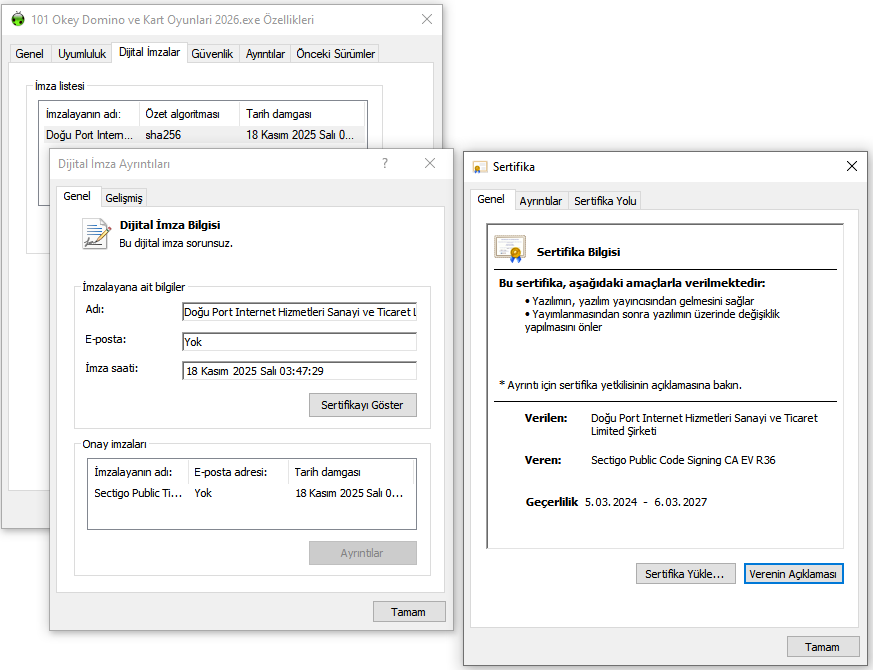
Since we’re on the subject of security, I must mention our Microsoft Extended Validation (EV) Code Signing Certificate. Every EXE file belonging to our game software is digitally signed with this certificate.
For us, security is not an option; it is a necessity. By utilizing the Microsoft EV Code Signing certificate—a credential held by very few organizations in Turkey—we protect our software with the highest digital signature standards available.
Unlike standard certificates, this authority is granted only after undergoing rigorous physical and legal audits conducted by Microsoft itself. This process authenticates the origin of our EXE files and certifies that they are free from any malicious tampering.
Every time you download our files, you can see the "Dogu Port" guarantee embedded within our digital signature:
Our Application Signed with Microsoft EV Code Sign
The Help Lobby
When a member was banned, they were restricted from entering any of the game lobbies. But what if the ban was unfair? How could they plead their case? Initially, our dispute mechanism was simple: "If you feel you’ve been treated unfairly, email 34oyunu@hakkarim.net." As you can imagine, this wasn't an intuitive or easy path for every user level.
Normally, players could have explained their situation to an Inspector live within the game, but since a ban blocked all entry, email remained the only bottleneck.
Lobby 1 had served as our training and flagship room, but to create a more organized and accessible support mechanism, we eventually transitioned away from Lobby 1 and launched the Help Lobby (Yardım Salonu).
Like any other lobby, this one had its own Head Admin and a team of moderators selected by that admin. These moderators were essentially "Inspector Candidates." After serving here for a year or two and demonstrating success, they were promoted to the rank of Inspector.
When a member had an issue or a ban to contest, they could easily enter the Help Lobby and "open a table." A Help Admin would join their table, listen to the grievance, and escalate it to the appropriate higher tier: an Inspector for player-related issues or a Coordinator for admin-related disputes.
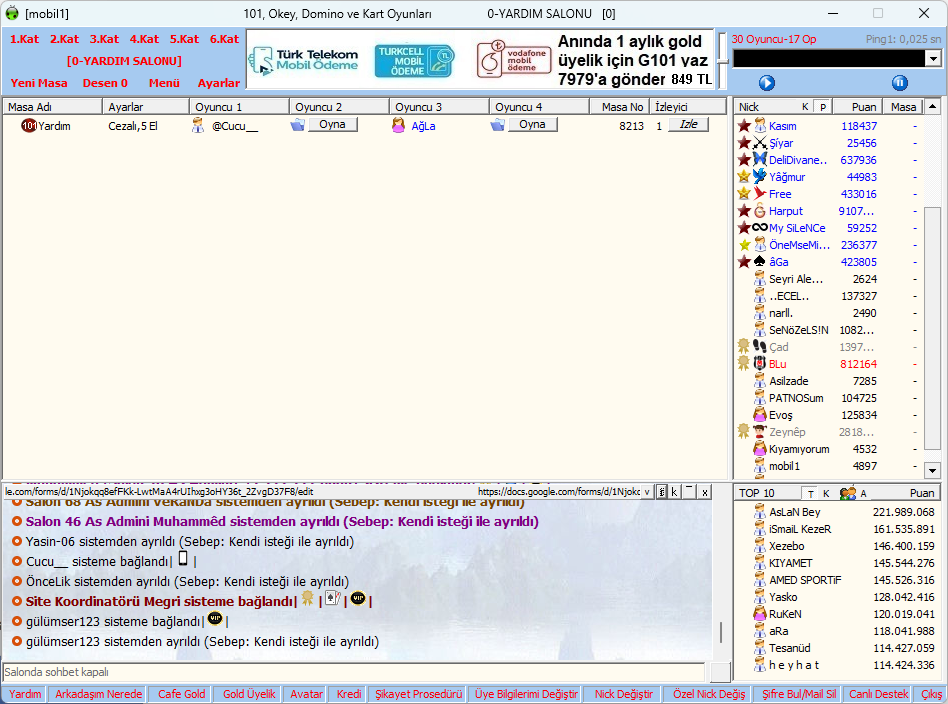
This setup made management far more accessible to users while providing a structured environment to train "rookie" admins under the guidance of seasoned Inspectors and Coordinators.
We later expanded this system by launching the Live Support (Canlı Destek) line, which is monitored by our Inspectors nearly 24 hours a day.
Although the Help Lobby belonged to the system itself, its management was autonomous, much like the other lobbies. All authority to appoint or dismiss moderators rested with the "Head Admin" we selected for that room.
Perhaps the most striking fact that summarizes the level of maturity Hakkarim.net management has reached is this: I have never personally met—or even known the real identities of—some of my senior officials who have been serving at the highest levels for 10 to 15 years, maintaining order for millions of members.
This is not a failure of oversight; on the contrary, it is a testament to the success of the system we built and the common language we established. The system selects its own leaders from within, trains them, and sustains that core spirit without needing my personal intervention.
Delphi Power
I began developing our game software in 2005 using Delphi 7. Back then, all of our competitors were using Java Applets, and later, Flash became the trend.
While both of those technologies have since been buried in the "digital graveyard," the Delphi 7 we chose remains alive and kicking even after 21 years.
 Delphi 7: The backbone of our legacy systems.
Why Delphi?
Delphi might not be as popular today as it was back then, but we are still loyal users. In fact, our Windows client and server applications are still running on Delphi 7—it’s incredible that a 24-year-old technology still works like clockwork. Our Android and iOS applications are also built with Delphi, utilizing the latest version, Delphi 13.
Even though we hold a Delphi 13 license, we keep certain core components in Delphi 7. As the saying goes: "If it ain't broke, don't fix it." :)
If I were to travel back to 2005 today, what would I choose? Still Delphi. At that time, the primary alternative was C# (a language I know well enough to have authored several books on, just as I have for Delphi). However, the technical advantages of Delphi were undeniable.
Downloading our 1 MB game client took about 3 minutes on a 56K modem.
The program I wrote in Delphi was only 1 MB and was a completely standalone executable with zero dependencies. On a 56K dial-up connection, downloading 1 MB took 3 minutes; had I used C#, downloading the required .NET Framework libraries would have taken over an hour. If I had chosen Java or Flash, the project would have disappeared into the digital graveyard years ago. It was the best choice then, and I believe it still is.
Full Stack Delphi
When I shared this history on the r/delphi subreddit, it created a global "wow" effect. The post gained so much traction that Ian Barker, the Developer Advocate from the US-based company Embarcadero (the creator of Delphi), personally reached out to invite me for a guest blog post and a webinar. Motivated by this global recognition, I wanted to share more specific details about the technical engine behind hakkarim.net.
The most crucial detail is that since day one, the project has been a complete Full Stack Delphi ecosystem. It’s not just the game client; the entire web infrastructure was also developed with Delphi using WebBroker (CGI & ISAPI). There is no PHP, no ASP, and no Node.js in our stack—everything from the server-side to the client-side is pure Delphi. You can see the real-world results of this architectural choice in our server performance metrics.
In response to a technical question on Reddit, I shared a real-time screenshot of the server load:
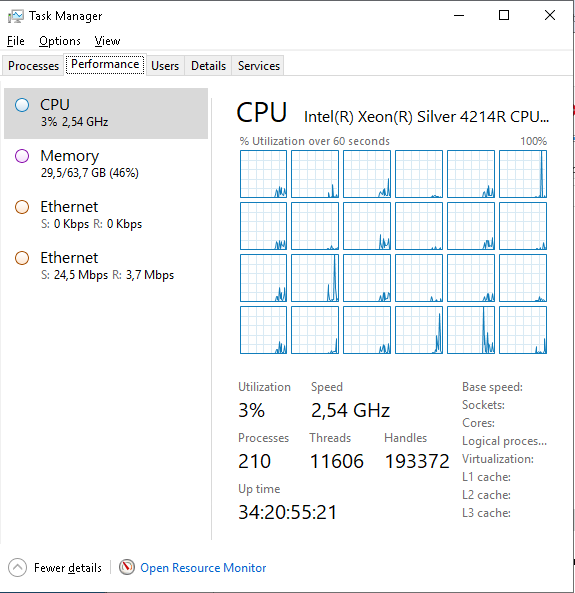 CPU Usage: 7,000 concurrent players, 25 Mbps bandwidth, 34 Days Uptime
The 3% CPU usage shown in the image represents the total load of 7,000 concurrent players (running 210 applications and 11,606 threads), the database server, and the web server utilizing 25 Mbps of bandwidth. Furthermore, this performance was recorded with 34 days of continuous uptime. This duration is typically the maximum limit we reach before being forced to restart for Windows Updates; otherwise, this native code written in Delphi is stable enough to run for months without a single restart.
The Imitators
In 2005, I was the first person in the world to write the 101 Okey game code. In 2006, another major company developed their own version—which is perfectly normal, as anyone can develop games. However, they went as far as copying the "How to Play" instructions directly from us; we just laughed it off.
Later, some went even further by creating exact clones of our application. They copied us so meticulously that even the default nicknames were identical! :)
Hundreds of imitator sites were launched. Many of our members urged us to take legal action, asking, "Why don't you sue them?" But we never bothered to pursue any of them. Today, not a single one of those sites remains active.
They managed to imitate the code, but they could never replicate the spirit of Hakkarim.net.
The Visionary Nature of Our Laws
Article 18 of the Income Tax Law was written with such a visionary perspective:
The revenues obtained by authors, translators, sculptors, calligraphers, painters, composers, computer programmers, and inventors—and their legal heirs—from works such as poetry, stories, novels, articles, scientific research, computer software, interviews, cartoons, photographs, films, video tapes, radio and television scripts, published in newspapers, magazines, computer and internet environments, radio, television, or videos, or from selling, transferring, or renting their rights to these works, are exempt from Income Tax.
In essence, the legislative will says: "These are critical fields; pursue them, and I will not demand taxes from you—nor from your heirs even after you are gone."
The influence of engineer-leaders like Demirel, Erbakan, and Özal in drafting such visionary laws is undeniable.
The "computer programmer" category was added to the Income Tax Law as early as 1987 by Turgut Özal (himself an Electrical Engineering graduate). It was a remarkable vision for its time.
Support for computer programming was integrated into our laws as far back as 1987.
The same vision is evident in the Technology Development Zones law enacted in 2001 during Bülent Ecevit's premiership.
With this law, significant corporate-level support began to flow toward software and R&D firms.
These exemptions, initially granted for 10 years, have been progressively extended to 2028 by subsequent AK Party governments, continuing this institutional state support for computer programming.
In 2001, the Technology Development Zones law was passed to pioneer Silicon Valley-style clusters.
However, we witnessed that the bureaucracy struggled to keep pace with this visionary structure.
Bureaucracy’s distorted view of game software
At a conference of the Game Developers Association in Istanbul, I personally heard the association president lament that "we cannot overcome the bureaucracy's skeptical gaze toward games." This highlighted a national issue: despite being larger than Hollywood, the gaming sector's importance was only truly validated in our country after two Turkish gaming giants (Peak and Gram Games) were acquired at billion-dollar valuations.
From our very first years, we faced this bureaucratic resistance. Yet, we witnessed time and again that the same vision held by the legislators was also shared by the judiciary.
During our legal disputes with the bureaucracy, both the local Tax Courts (Erzurum and Van) and the higher Regional Administrative Courts and the Council of State issued legendary rulings that read like manifestos.
A member of the Council of State who reviewed our file shared this anecdote: "We said among ourselves, 'This man achieved this from Hakkari.' You might expect it from Istanbul, but instead of supporting someone who did this from Hakkari, they hindered him and made it difficult for him to exercise his legal rights."
Moving to Erzurum
As the business continued to scale, I incorporated the company in January 2007. It became nearly impossible to fulfill my duties as a lecturer while managing this growth; therefore, in November 2007, I resigned from my position in Hakkari and returned to Erzurum.
Top Taxpayer Rankings
By 2008, we had broken into the top 15 companies in a league that included industrial giants like Aşkale Çimento. Although software development qualified for income tax exemptions, we had established a corporate structure while still operating as a "home office."
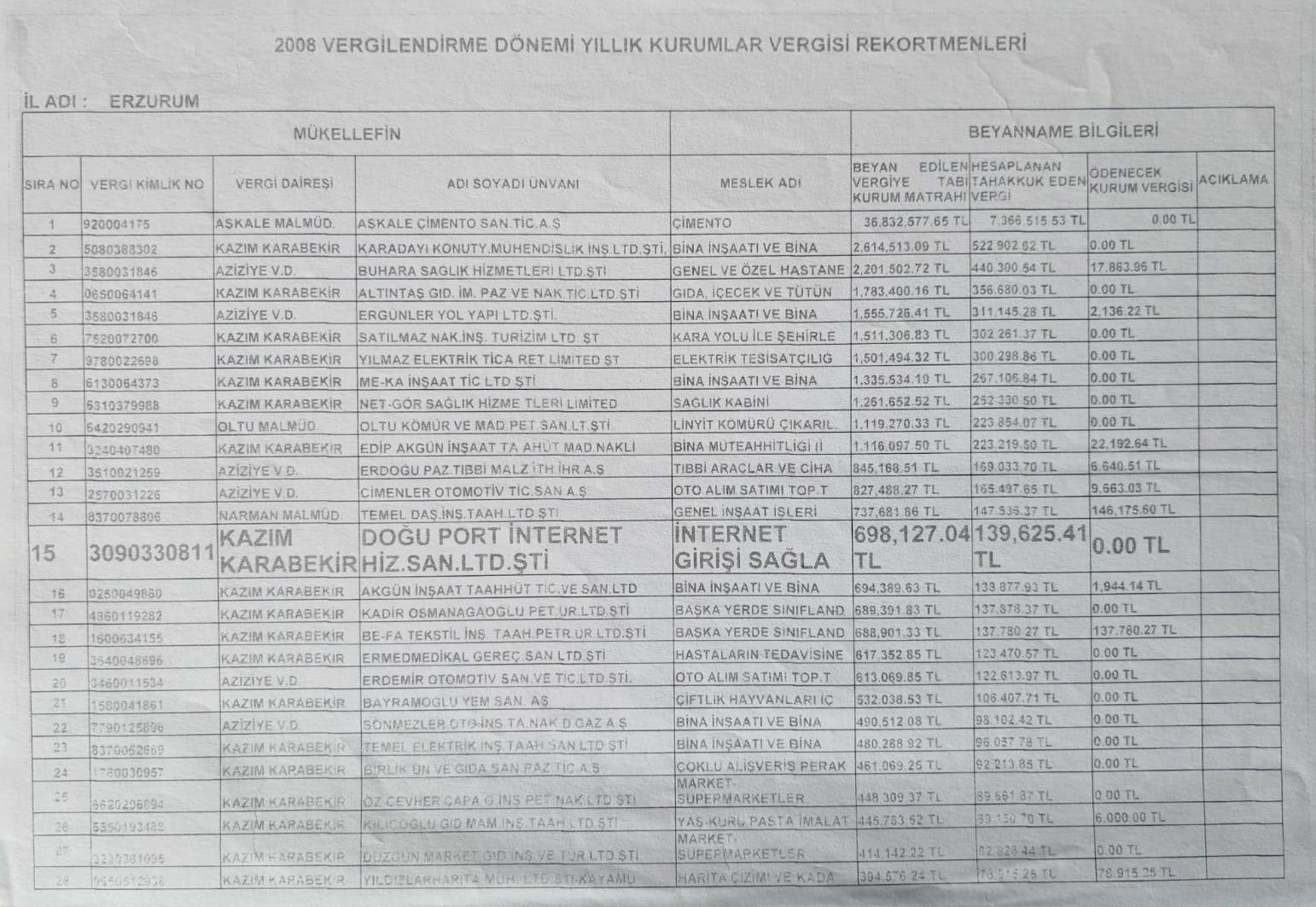
We were competing in the same lane as massive industrial enterprises, at least in terms of the taxes we contributed, all from a single room at home.
Ata Technopark
In 2009, the Erzurum Ata Technopark (Teknokent) was just being established. Since we were one of the few software firms in the city, there was a strong insistence that we join. As a result, we moved in as one of the very first resident companies of the Technopark.

2013: Bureaucracy Strikes Again
In 2013, we began facing bureaucratic hurdles once more. Since we were now an incorporated company, the disputes shifted from Income Tax Article 18 to the rights and exemptions granted under Law No. 4691 on Technology Development Zones (TGB). Once again, we found ourselves in a legal battle.
Just as before, we proved our case in court and had our rights ratified by the Council of State.
However, these legal processes forced us to struggle for nearly a decade.
In this context, I would like to extend my deepest gratitude to Erzurum’s legendary Financial Advisor, Turgut Aktaş, for his professional guidance, and to Samet Aksakallı, whose immense efforts in tracking our files were vital throughout this journey.
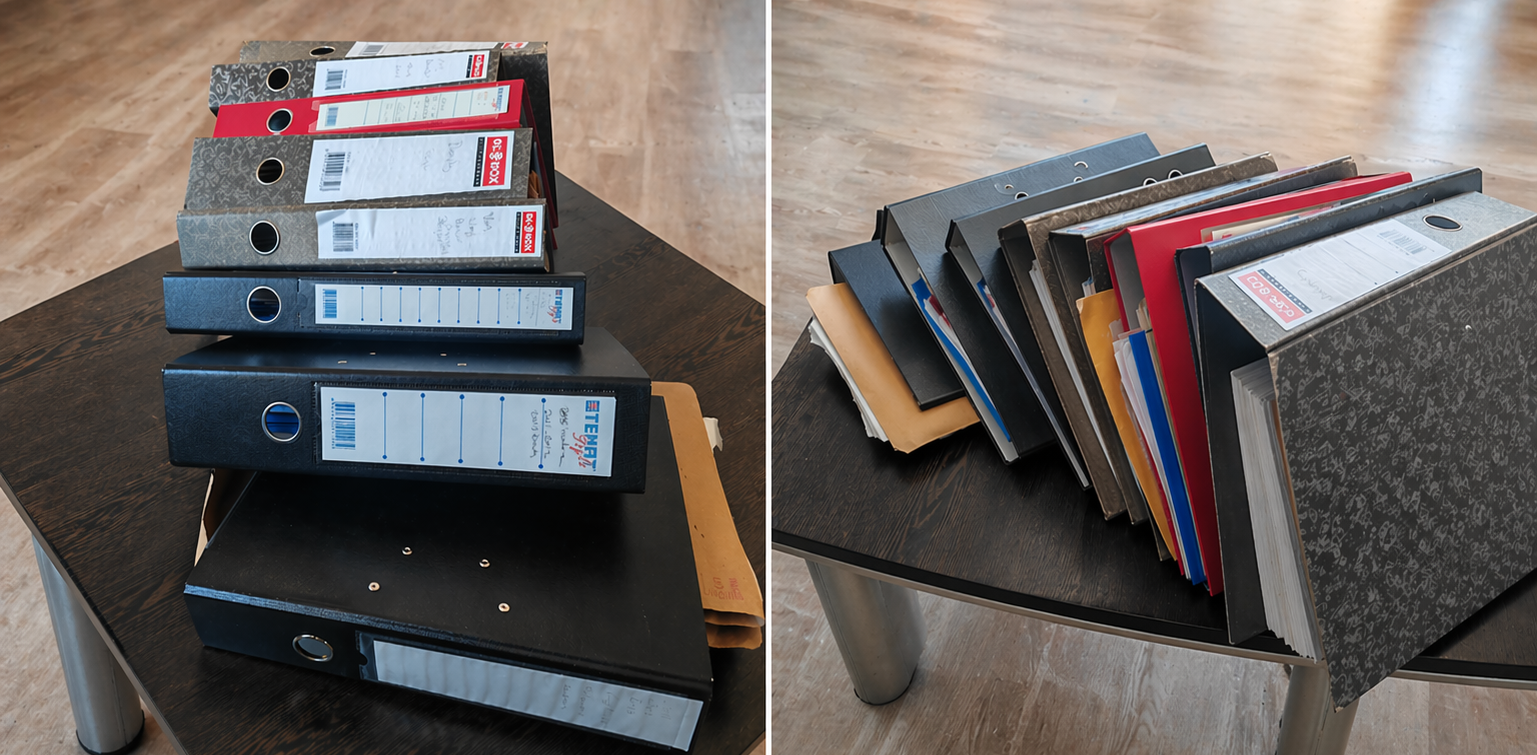
It seems the legislative will finally heard the grievances of the Game Developers Association president regarding the "bureaucracy’s skeptical gaze." On January 1, 2019, the legislator made another visionary move by explicitly adding the term "Game" to the VAT (KDV) Law. This high-level legal amendment effectively put an end to the potential friction between bureaucracy and game developers.
2019: The term "Game" was explicitly added to tax legislation.
Peak Games
Early 2011—I remember the date clearly because the Winter Olympics were being held in Erzurum that February. There was excitement everywhere: new sports facilities, the ski jumping towers (the ones that unfortunately collapsed later), and so on.
My phone rings. "Hello, I’m Sidar Şahin, founder of Peak Games." At the time, I didn't know him well. He mentioned owning a competing 101 Okey firm but acknowledged that hakkarim.net was the undisputed market leader and expressed interest in a partnership.
He invited me to Istanbul for a meeting. I replied that I had no plans to visit Istanbul soon but would stop by if I did. "Then we’ll come to Erzurum," he said. I welcomed them, mentioning the Winter Olympics were ongoing. "Great, see you then," we said, and hung up—but the follow-up never came.
Later, I saw the news that changed the industry:
Peak Games sold its card games division to Zynga for 100 million dollars.
Allow me a moment of self-reflection:
Why were we late to mobile? Because we were born in the PC era. In 2005, smartphones didn't exist yet. When Sidar Şahin called in 2011, we were indeed the biggest in the sector. However, right around those years (post-2010), smartphones began to dominate; PC users dwindled while mobile users surged.
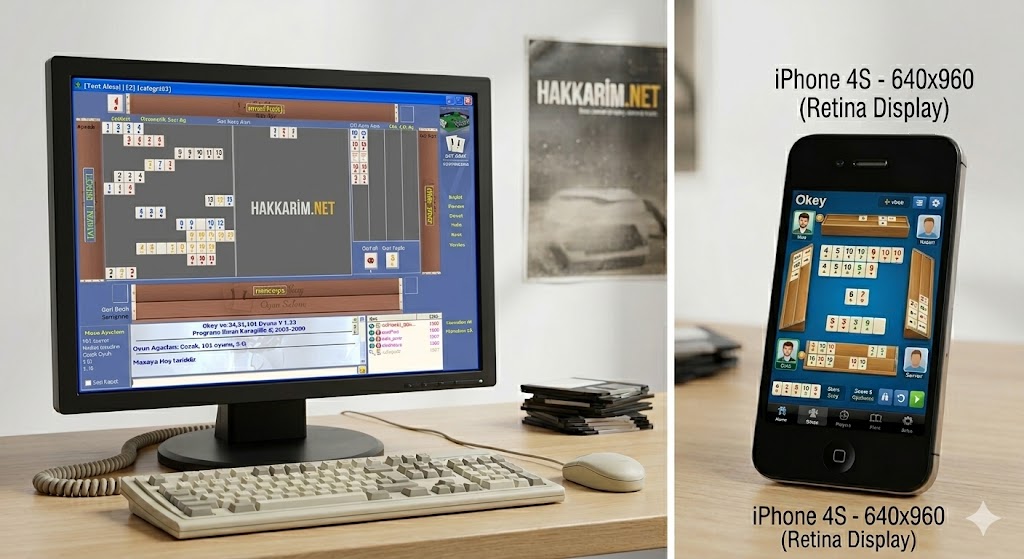
Firms like Peak Games, which started directly in the mobile age, developed mobile-native applications. Meanwhile, we had 50,000 concurrent PC players at any given moment. We struggled with the challenge of migrating the PC experience they loved to a mobile platform.
Even today, our mobile apps offer an experience very close to the PC version. Our millions of members were used to seeing everything on a vast PC screen; providing that same "wide-open" experience on tiny mobile screens was no easy feat.
We could have written a completely new app for mobile-first users, but we prioritized our existing PC community, trying to craft the most suitable mobile experience without alienating them.
Our competitors are now part of a global giant (Zynga), but we remain independent—true to our roots.
Since our first day in 2005, we have never viewed losing money as the problem; our only real concern has been losing members.
My Only Competitor Is Google :)
The IAB (Interactive Advertising Bureau), the world’s largest digital marketing and advertising association—founded in the US in 1996 and currently operating in 45 countries—releases monthly reports listing the most visited and engaging websites for the benefit of digital advertisers.
In the reports for December 2014 and January 2015, we were declared the number one website in Turkey for the longest time spent per PC user, effectively surpassing global giants like Google and Facebook.
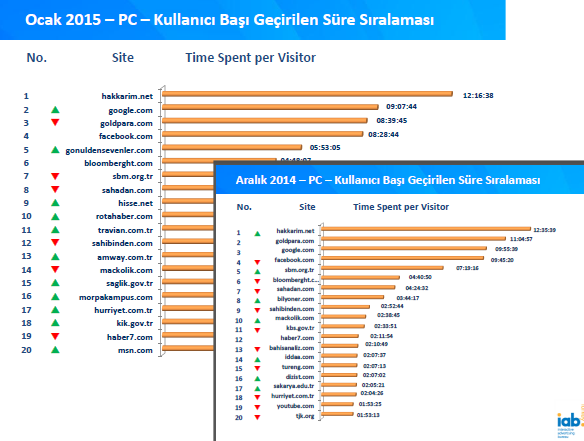 The moment we surpassed Google and Facebook in time spent per PC user (2014-2015).
MediaCat, the most prestigious and long-standing publication in the world of marketing, advertising, communications, and media, recognized this success years ago (2010). In an article titled "EQUALITY OF OPPORTUNITY FOR THE PERIPHERY," they featured our story as follows:
"Digital information technologies and the internet offer a sort of equality of opportunity not only to the center but also to the periphery. I encountered one of the best examples of this in the 'Local Internet Map' provided with this month's Digital Age. The most striking site on this map, which displays Turkey’s most popular local websites, is hakkarim.net, which demonstrates an incredible traffic performance for a local site. When I first saw the traffic figures, they seemed unbelievable, but after digging a little deeper, the story behind the success emerged."
Media Coverage
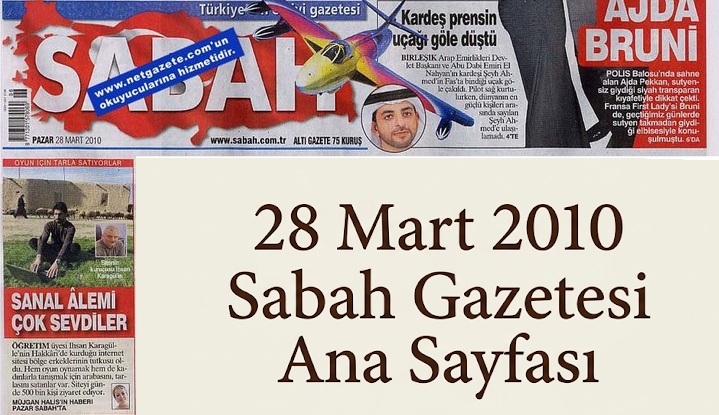
Since we launched in 2005, we have frequently appeared in the local press. However, in 2010, we began to gain traction in national and international media with full-page features.
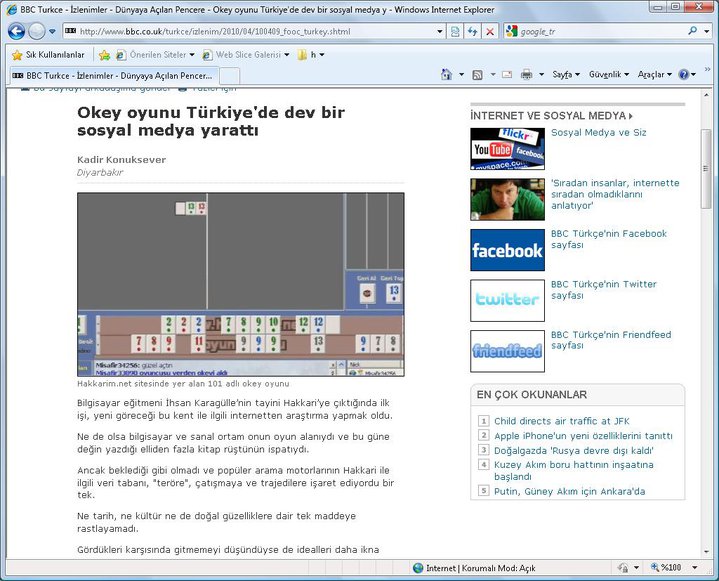
BBC News
On April 9, 2010, BBC News published an extensive feature titled "The Game of Okey Has Created a Massive Social Network in Turkey," highlighting Hakkarim.net:
"When computer instructor İhsan Karagülle was assigned to Hakkari, his first move was to research the city online. After all, the virtual world was his playground, and the fifty-plus books he had authored were a testament to his expertise. However, it wasn't what he expected. The databases of popular search engines pointed only to 'terrorism,' conflict, and tragedy regarding Hakkari. He couldn't find a single entry about its history, culture, or natural beauty. Though what he saw initially made him consider not going, his ideals were more persuasive. He set out. Upon arriving, he realized the digital world was doing a great injustice to Hakkari's breathtaking, untouched beauty. His first action was to purchase a domain name and establish Hakkarim.net—little did he know it would turn into a phenomenon." The report concluded: "The fairytale-like existence of Hakkarim.net, now a phenomenon, continues to grow with its admirers and critics alike. No one knows how long this '101 Nights Tale' will last."
Many more "1001 nights" have passed since that report. Original BBC Article
Sabah Newspaper
On March 28, 2010, we were met with a major surprise: Sabah Newspaper—one of Turkey's highest-circulation dailies—dedicated the entire front page of its Sunday supplement to Hakkarim.net.
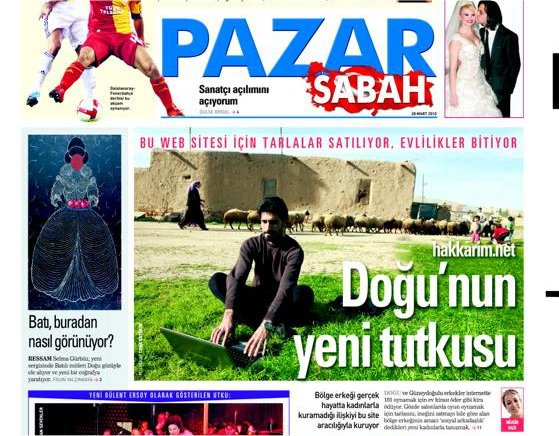
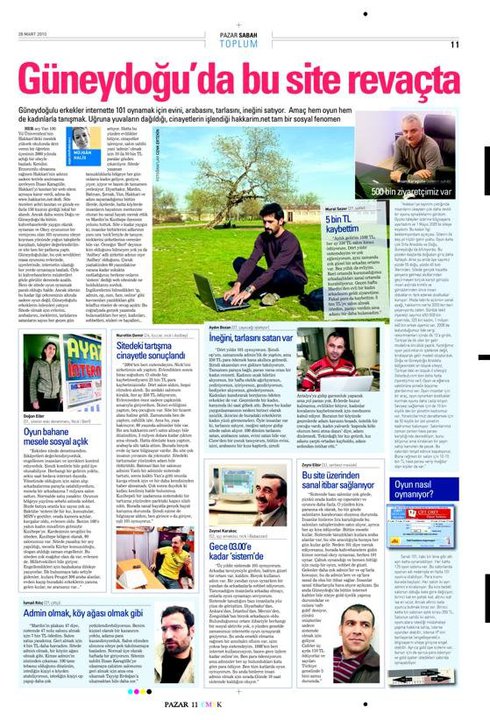
2021: International Recognition
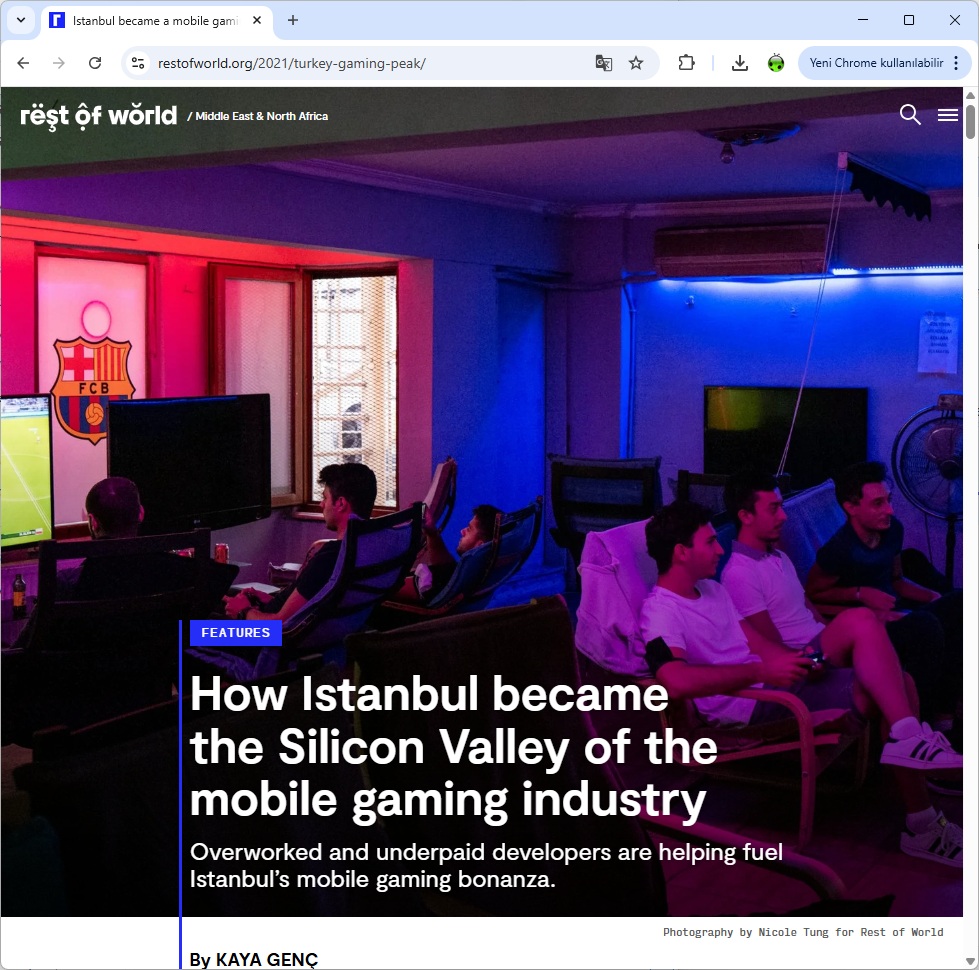
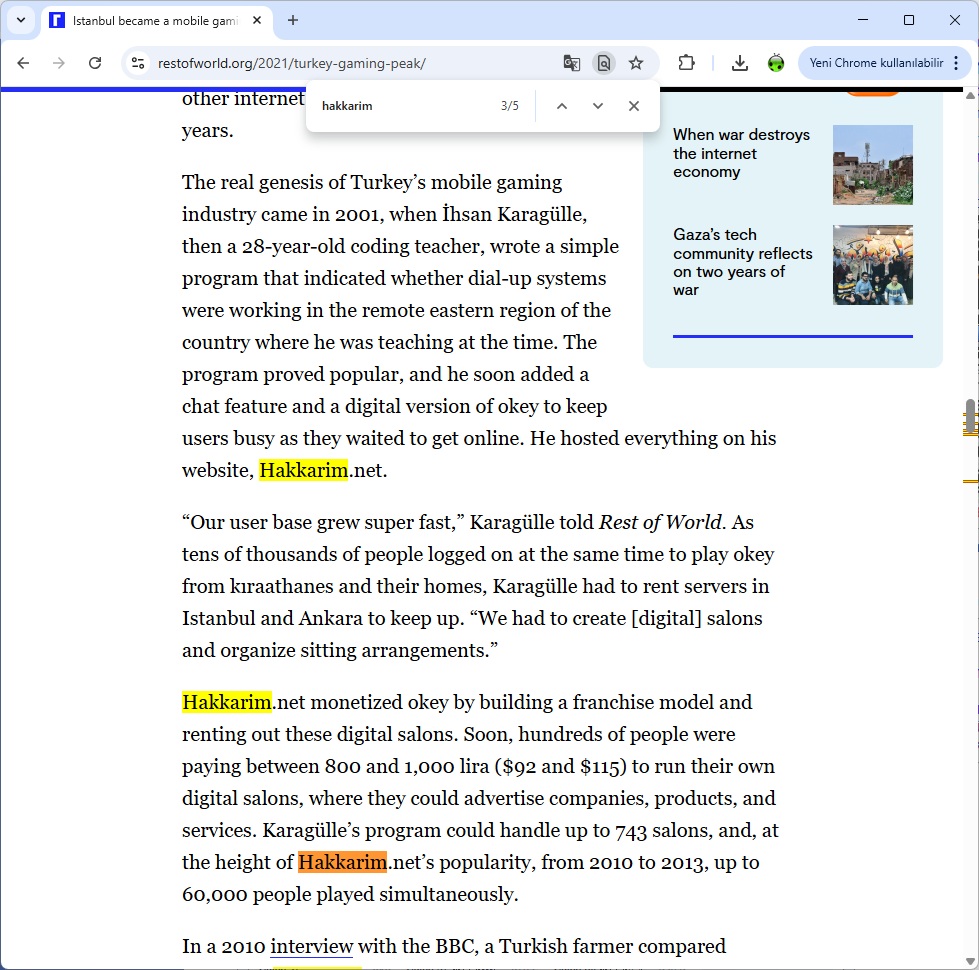
On September 30, 2021, Rest of World—one of the world's most respected international technology publications—featured our site extensively in a deep-dive analysis. The article explicitly stated: "The real genesis of Turkey’s mobile gaming industry came in 2001, with that first program written by İhsan Karagülle in Hakkari."
The article highlighted how we built a digital structure that "shattered prejudices" by bringing different cultures together at the same virtual table. While the piece was titled "How Istanbul Became the Silicon Valley of the Mobile Gaming Industry," it clarified in the following pages: "The real genesis of Turkey’s mobile gaming industry came in 2001, when İhsan Karagülle, then a 28-year-old coding teacher, wrote a simple program that indicated whether dial-up systems were working in the remote eastern region of the country where he was teaching at the time. The program proved popular, and he soon added a chat feature and a digital version of okey to keep users busy as they waited to get online. He hosted everything on his website, Hakkarim.net." In essence, it documented that the foundations of the billion-dollar industry now centered in Istanbul were actually laid by İhsan Karagülle in Hakkari in 2001.
Rest of World | Global Tech Analysis
The 2021 feature examining the origins (Genesis) of Turkey's gaming industry:
Scientific Publications
In a scientific article published in the international peer-reviewed journal The Anthropologist in 2016, Prof. Dr. Bünyamin ATICI included the following important findings from his research on hakkarim.net conducted with 165 participants:
- The site has been influential enough to change the lifestyles of men in the region; so much so that gaming at the computer has replaced the traditional coffeehouse culture.
- Members use "nicknames" rather than their real names, and these nicknames find a place in daily life and even in company names.
- 28.5% of the participants use the site for more than 40 hours per week.
- The primary purposes for using the internet are entertainment (73.3%) and communication (18.2%).
- Members define being a member of Hakkarim.net as devotion, unrequited love, happiness, belonging, and fun, respectively.
- As a result of the research, it was found that women's attitudes towards the site were more positive than those of men.
- In this geography struggling with issues such as terrorism, unemployment, and violence, the virtual world has become a refuge where people try to compensate for their deficiencies in the real world.
- Although the site is virtual, its effects are extremely real in terms of the friendships established.
You can access the relevant article here
Academic data: Hakkarim.net, a center of devotion, unrequited love, happiness, belonging, and entertainment, with a usage rate of over 40 hours per week, where women have a more positive outlook and computer use has increased instead of coffeehouses.
Some opinions from 165 participants in the scientific study are as follows:
- Real life exists on this website.
- I have been playing 101 on the system for three years. I joined through a friend's recommendation and stayed once I saw the beauty of the atmosphere.
- There is not just entertainment on this site, but also friendship.
- I have been on the system for four years and have built friendships here that I couldn't establish in real life.
- Being a member of this site is a reason for prestige.
Prof. Dr. Bünyamin ATICI stated in the conclusion of his research that he found the following information surprising:
Due to regional limitations and deprivation, the site has created a strong area of belonging for users. So much so, it is a surprising finding that participants felt no need to hide their identities in the virtual environment.
Radios: Our Collective Voice
From the very first day I programmed the game, I included a radio module. While we briefly operated our own station, "Radio 101," I soon realized we were facing the same "Lobby 5 syndrome"—centralization wasn't the answer. So, I opened the radio platform completely free of charge to all other broadcasters.
Any station joining the system gained immediate access to Hakkarim.net's concurrent user base, which peaked at nearly 50,000 online players.
The system hosted 15 different stations, ranging from local broadcasters to those exclusive to the site. Bu fostered immense musical diversity and healthy competition.
Radio stations would launch campaigns to convince lobby owners to feature them. DJs would "visit" the lobbies that added their station, playing user requests and engaging directly with the crowd.
One member, who had extensive experience as a local DJ in Samsun, once told me: "Broadcasting on Hakkarim.net is a completely different feeling. In local radio, you feel like you're talking to a wall; here, there are living, breathing people. When we enter a lobby, welcomes fly across the screen, we take requests in real-time, and we can personally honor the admins who choose us."
"Broadcasting on Hakkarim.net is a completely different feeling."
We collaborated with three major music production associations. For any radio station to be approved, we required them to first sign licensing agreements and pay royalties. Only after receiving an official confirmation from these associations would we enable their broadcasting rights.
Over time, as national broadcasting (RTÜK) regulations changed and imposed heavy conditions on commercial digital stations, we removed all commercial entities and kept only the amateur broadcasters who opened their microphones from home.
In truth, it was this amateur spirit that distinguished us from billion-dollar gaming companies.
When our site launched, Yahoo Games was the global leader, yet today it is nearly forgotten. Meanwhile, Hakkarim.net remains Turkey’s largest 101 Rummy community, fueled by that same amateur passion.
Pluralism = Hakkarim.net
Given the massive concentrated audience, many offered us significant sums for exclusive radio rights. However, I rejected every offer to preserve our pluralism.
Accessing 50,000 concurrent listeners on Hakkarim.net has always remained free for any broadcaster who completes the legal procedures.
Our Esteemed Guest Artists
Having a concurrent audience of 50,000 listeners was a milestone that very few online radio stations could ever hope to achieve. Over the years, we hosted many precious artists—sometimes through the efforts of their PR teams, and sometimes because the artists themselves reached out after hearing about the sheer scale of our community.
Through the dedicated efforts of our DJs, we had the honor of welcoming many performers. Among those I remember fondly today are: Hakkı Bulut, Muharrem Aslan, Cevdet Bağca, Reyhan Karaca, Ömer Topçu, Şafak Sönmez, Tayfun Uzun, Raperin, Ekin, and Hamiyet.
Welcoming these beloved figures—who have built a throne in the hearts of the people—into Hakkarim.net’s game lobbies was a great honor for us. The warm responses we received during live broadcasts, following our DJs' announcements like, "Our founder İhsan Karagülle welcomes you," were truly priceless. Some artists even created their own nicknames, sat down at the tables, and played games directly with our users.
"This is what I love most about our country; the fact that everyone, even our most famous artists, remains 'one of the people'."
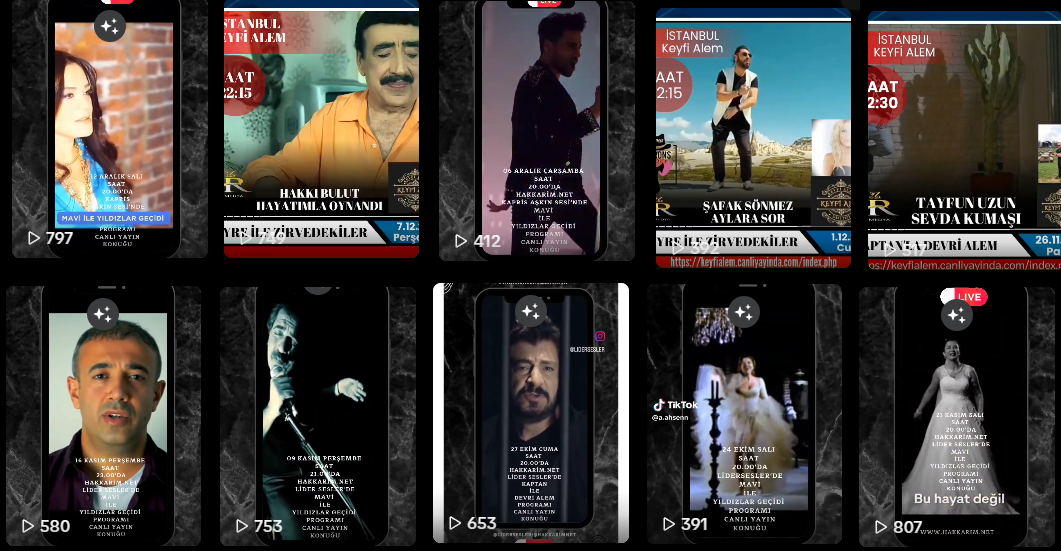 Some of the esteemed artists we have hosted on our platform.
You can view the promotional stories prepared by our DJs for the artists who visited our site on this page.
Rewarding Loyalty: The Credit System
To reward players who spent significant time on the platform, I introduced the Credit System.
Depending on their administrative level, players could earn between 1 and 4 credits for the duration they remained in the system. These credits could then be converted into points, Gold memberships, or Avatar statuses.
After years of accumulation, many players sat on vast reserves of credits without converting them. In late 2019, just before the pandemic, I brainstormed ways to revitalize this economy and launched the idea of "X-Tables" that multiply points using credits.
By spending 250 credits to open an "x2 table," you could play with a double point multiplier for 24 hours. If you won, you gained double the points; if you lost, you lost double.
Initially, I opened a test lobby with x2, x4, and x9 multipliers. Many members initially dismissed the system as "illogical," asking why anyone would spend credits just to open a table—yet, ironically, those same skeptics were the ones who never left the test tables.
Naturally, the system became a massive hit. So much so that a 9x multiplier was no longer enough; it escalated to 99x, 111x, 123x, and eventually reached a 999x multiplier. In a standard game where you might win or lose 11 points, an x999 table pushed the stakes to nearly 11,000 points.
This provided an adrenaline rush of winning or losing months' worth of progress in a single match.
Later, I allowed members to use their credits to send meaningful digital gifts to each other's profiles. This feature was embraced so warmly that receiving a digital gift on your birthday became as symbolic and valuable as receiving a real bouquet of flowers.
"Tea for Everyone on Me!"
Alongside the credit system, we introduced a feature that allowed members to use their credits to send gift packages to their specific table or to the entire lobby.
These packages could contain symbolic gifts like tea or lemonade, but they also offered game-specific rewards such as credits, points, and "pot points" (çanak puanı).
The Ranking (Klasman) System
We developed a tiered ranking competition model where winners climb to the next level and losers drop two levels down. The system tracks progress automatically; as players win, their rank increases, ensuring they only compete against opponents of a similar skill level.
This system became so popular that in 2010, we organized a year-long ranking competition with a car as the grand prize. At the conclusion of this marathon, a member from Elazığ won a brand-new automobile from our site. Our Ranking Page
 The winner of the automobile in our annual Ranking Competition.
Lobby Tournaments
We also developed a micro-level version of the ranking system tailored for individual lobbies. We programmed a five-round competition structure consisting of Qualifiers, Quarter-finals, Semi-finals, and the Final, all tracked automatically by the system.
Players can join a tournament during the day and finish it within hours. Even if they don't complete it immediately, the system saves their progress, allowing them to resume the tournament from exactly where they left off—even months later.
Gold Membership: Privilege vs. Principles
We offer 11 distinct advantages to our Gold Members, but the primary draw has always been the ability to enter "full" lobbies. Naturally, everyone wants to be in the same lobby; however, accommodating tens of thousands in a single room is both a technical nightmare and a chaotic experience for the users.
To manage this, we divide players into groups of 100. For those who insist on being where the action is or joining their friends regardless of capacity, we developed the Gold Membership model. It allows entry even when a lobby is technically at its limit.
As a developer, I occasionally create test accounts to monitor the game firsthand (shout out to test4 :)).
One day, while testing, a player disconnected. We have a 7-minute reconnection rule: while another player can step in to keep the game moving, the original seat owner has priority. If they return within 7 minutes, the system automatically reinstates them to ensure their experience remains uninterrupted.
However, I noticed a player who couldn't return even after the 7-minute mark. They were having a great conversation before the drop, but they were locked out because the lobby was full.
This was a negative experience not just for the disconnected player, but for the three friends left at the table.
That very day, I updated the source code. I implemented a rule: if a player disconnects during an active match, the system allows them back into the lobby even if it’s full—regardless of whether they are a Gold Member or not.
Within a few months, this single adjustment caused our Gold Member count to plummet from 1,500 to 300. It became clear that many were purchasing Gold status simply to avoid the frustration of interrupted games. Despite the significant loss in revenue, this feature became a permanent Hakkarim.net standard—a level of fairness that is likely unique in the global gaming industry.
Because an unfinished game is such a poor experience, we added further safeguards to prevent "rage-quitting" (intentionally leaving when losing):
If a player leaves a match intentionally, the system imposes an automatic 2-hour ban. Furthermore, if their replacement loses, the original player loses double points, and their "Incomplete Game" record increases by one.
No one wants to play with a user who has a history of abandoning matches.
This creates a strong incentive for players to return and finish what they started, preserving both their points and their reputation.
To facilitate this, we provide a 7-minute grace period for reconnections.
When a player drops, a substitute can fill the seat, but the system issues a warning: "You are subbing for User XX; if they return, you will be automatically removed." If the original owner returns within the grace period, the system handles the swap instantly without requiring any manual intervention or awkward dialogue.
This prevents any potential arguments or friction between players over who "owns" the seat.
We prioritize the completion of ongoing games so highly that even when a lobby is temporarily closed due to rule violations—blocking even Gold Members—those with unfinished matches are still granted entry to finish their games.
The "Cekat" Issue: Fair Play vs. False Positives
In gaming systems where points are accumulated, a dedicated segment of the player base places immense value on their rankings.
Some of these players attempt to manipulate the system by opening four accounts (nicks) themselves or coordinating with a friend to use two accounts each. They deliberately lose with their secondary "throwaway" accounts to funnel points into their main accounts—a practice known within our community as "cekat." While this distorts the competitive landscape, preventing it without causing collateral damage to innocent players is incredibly difficult.
While some gaming platforms take aggressive measures against such tactics, we have always maintained a more moderate approach due to the high risk of error and potential for abuse of power.
A player might simply be on a lucky streak for a few consecutive hands, or the stones discarded by the person next to them might happen to be exactly what they need several times in a row. Accusing someone of cheating just because they have good fortune is a risk we are unwilling to take.
Unless players explicitly confess to cheating, we do not act on complaints based solely on scoreboard anomalies or the number of stones taken from a side player. Furthermore, we consistently overturn any administrative actions taken by moderators based only on these subjective observations.
According to our management philosophy, the sorrow of a single innocent member banned by mistake is more significant than the unfair points gained by a cheater.
While this stance may have allowed some artificial inflation in the rankings, it has provided our millions of members with the peace of mind to play without the fear of being wrongfully banned.
The Internet Café Era
Until around 2015, what we might call the "Internet Café Era" was the system's most vulnerable point—its "Achilles' heel."
Our robust ban system was designed to prevent a disruptive player from logging back into the system with different nicknames from the same computer for the duration of the ban. Consequently, those looking to cause trouble gravitated toward internet cafés. This put café owners—who were simply trying to earn a living—in a difficult position.
During this period, we evolved our membership model and launched the CafeGold System. For the cost of just three individual Gold memberships, an owner could upgrade their entire café to "Gold" status. This was an incredibly attractive opportunity for café owners; it increased their foot traffic as players preferred "Gold-status" cafés, and it also extended the time customers spent at their computers.
At its peak, many internet cafés in eastern Turkey displayed signs in their windows stating: "Our Internet Café is a Hakkarim.net CafeGold Member."
Internet Café Signage
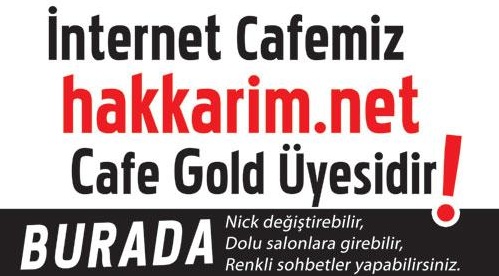
The CafeGold system created a bridge between us and the café owners, providing financial benefits to both parties while ensuring that millions of Hakkarim.net members prioritized these partner establishments.
More importantly, it served as a communication channel for moderation. For example, if trouble persisted in a specific café, we would alert the owner via their registered email: "Players using computers X and Y on these dates are causing disruption. If you do not prevent these users from abusing the system, your café's status will be revoked."
Through this network of nearly a thousand CafeGold members, we effectively prevented the decline of system quality that often stemmed from the anonymous nature of internet cafés.
The Last Meeting
When I first coded the site and administrative issues began to surface, I mentioned that we held almost daily meetings to establish a common stance and speak the same language.
In those sessions, which sometimes lasted for hours, we would exchange ideas on how to handle problems and determine the most ethical course of action. Looking at my notes today, I see that 8 years have passed since our last formal meeting.
The system has internalized such a unified language that for the past 8 years, we haven't even felt the need to convene.
At the heart of our management philosophy lies a single word: "Empathy."
During the years of intense administrative meetings, our golden rule was always: "Decide through empathy." That is how you reach the right conclusion:
If you are wondering whether to penalize a member for something they said to another, imagine those words were directed at you. If an admin has penalized a member, put yourself in that admin's shoes and ask, "Would I have done the same?"
When making a decision, never factor in the person’s administrative level or their financial contribution to the system.
Never listen to those who argue, "I’ve spent this much money here." Side with the person who is right. No one will ever hold you accountable and ask, "Why did you ban that person when they spent so much money?"
If you disagree with an admin's decision, appeal to our Inspector (Denetleyici). If you are unsatisfied with the Inspector's ruling, take it to the Coordinator. If the Coordinator’s decision feels wrong, appeal to the Official (Yetkili).
If an error has been made, it will surely be rectified at one of these stages.
One of the most intriguing aspects of Hakkarim.net is the invisible yet unbreakable bond we share with our members. We did have physical gatherings in the past; however, the last one took place in 2010—exactly 16 years ago.
After that day, we realized that meeting face-to-face in the physical world somehow breaks the pure digital magic established at those 101 tables. At the tables, people exist only through their thoughts, their wit, and their character. What someone wears, where they are from, or what they do for a living does not overshadow the 'human' bond at that table.
To preserve the magic of that 'imaginary homeland' built in the digital realm, we have only shaken hands through screens for the past 16 years. Perhaps the secret that has kept us connected for so long is that digital mystery where everyone knows each other only through their heart and their words.
Security is a Holistic Process
On November 18, 2019, a young computer engineering student visited my office to discuss an internship. While I was talking to my young colleague, I suddenly noticed an anomaly in the system. When I opened the Task Manager, I saw another active user—the ultimate nightmare for any administrator.
I immediately disconnected the user and checked the firewall. I was using static IPs at my home, office, and on mobile, and Remote Desktop (RDP) was strictly configured to only allow access from these IPs.
The firewall rules were intact; no one could have entered via RDP without a predefined IP. This left only one possibility: the IDRAC interface of the Dell servers, which allows remote access even at the BIOS level. This was the only way to bypass Windows firewall rules.
I logged into the hosting provider's IDRAC panel and confirmed it: the unauthorized entry was from an external IP. Changing the IDRAC password didn't stop the intrusion. Technical support was helpless, as they were encountering this situation for the first time.
I instructed them to shut down the IDRAC system entirely. While I continued my internship interview and sipped tea with the candidate, I was secretly fighting this massive anomaly in the background, trying not to let on that anything was wrong.
IDRAC allowed remote access to the computer's BIOS, but the server was running Windows Server 2008 R2—how had they managed to open an active session?
I was certain the flaw wasn't on our end. A quick investigation revealed that a vulnerability in the Dell IDRAC panel, combined with an exploit that allowed creating an administrator account on Windows 2008, had left systems compromised—a fact the datacenter was unaware of. I immediately grasped the gravity of the situation.
At the time, I had been reading about major firms falling victim to ransomware and extortion; now, the reason was clear.
Initially, it was difficult to convince the hosting firm; they suspected a vulnerability in our own software. However, once I found and sent them a foreign technical article proving the flaw in their IDRAC panels, they admitted the error and updated their systems. In doing so, I effectively saved hundreds of other firms from being hit by ransomware. Related Article
Reporting the Dell IDRAC Vulnerability
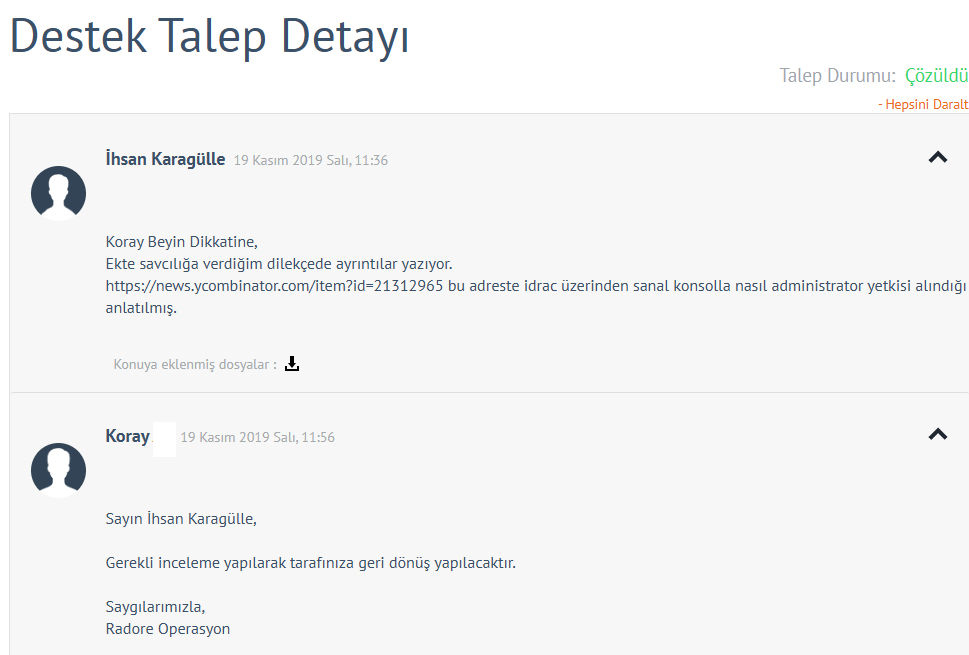
I prepared a legal file that same day and submitted it to the prosecutor's office the next morning. A few months later, I read the attacker’s defense from prison. The prosecutor, citing the solid evidence we provided, requested a conviction, noting the defendant's testimony was merely an attempt to evade justice.
This experience taught us a vital lesson: no matter how secure your code is, if your infrastructure partners are not equally vigilant, your entire security is at risk.
The technical article discussed a vulnerability identified on October 21, 2019. Our encounter with the same attack on November 18, 2019, due to the datacenter's failure to update IDRAC, was a classic zero-day exploit scenario.
Thanks to years of experience and being present at the helm, I was able to detect the slightest system lag, solve the crisis, and prevent a disaster that could have affected thousands of oblivious companies.
"If it works, don't touch it" :)
This was a wake-up call; the "don't touch if it works" mentality isn't always valid.
Since 2005, we had progressed from Windows Server 2003 to 2005 and then 2008 R2. We had stayed on that version for a long time, relying on the system’s legendary stability—a bit of "if it works, don't touch it" lethargy.
Although support was slated to last until 2023, 2019 was not a good year for an OS released in 2009. Ten years is an eternity for an operating system.
Shortly after, we migrated to Windows Server 2019 and moved to a different datacenter that did not utilize IDRAC.
Before Hakkarim.net: The Author Behind the Code
My first professional assignment was at the Ahlat Vocational School under Yüzüncü Yıl University. I was just 20 years old in 1994 when I began my career as a lecturer, teaching Computer Programming in this charming district on the shores of Lake Van.
Working in small, remote eastern towns often brings a sense of isolation and boredom. This very feeling, which later inspired the coding of my Okey game, first took hold in Bitlis/Ahlat. As a result of this creative restlessness, I wrote my first programming book in 1995. Much like Hakkarim.net, it became an instant success. Over the next decade leading up to 2005, I authored 50 books on programming and various computer science topics. Search My Books on Google
My Publications
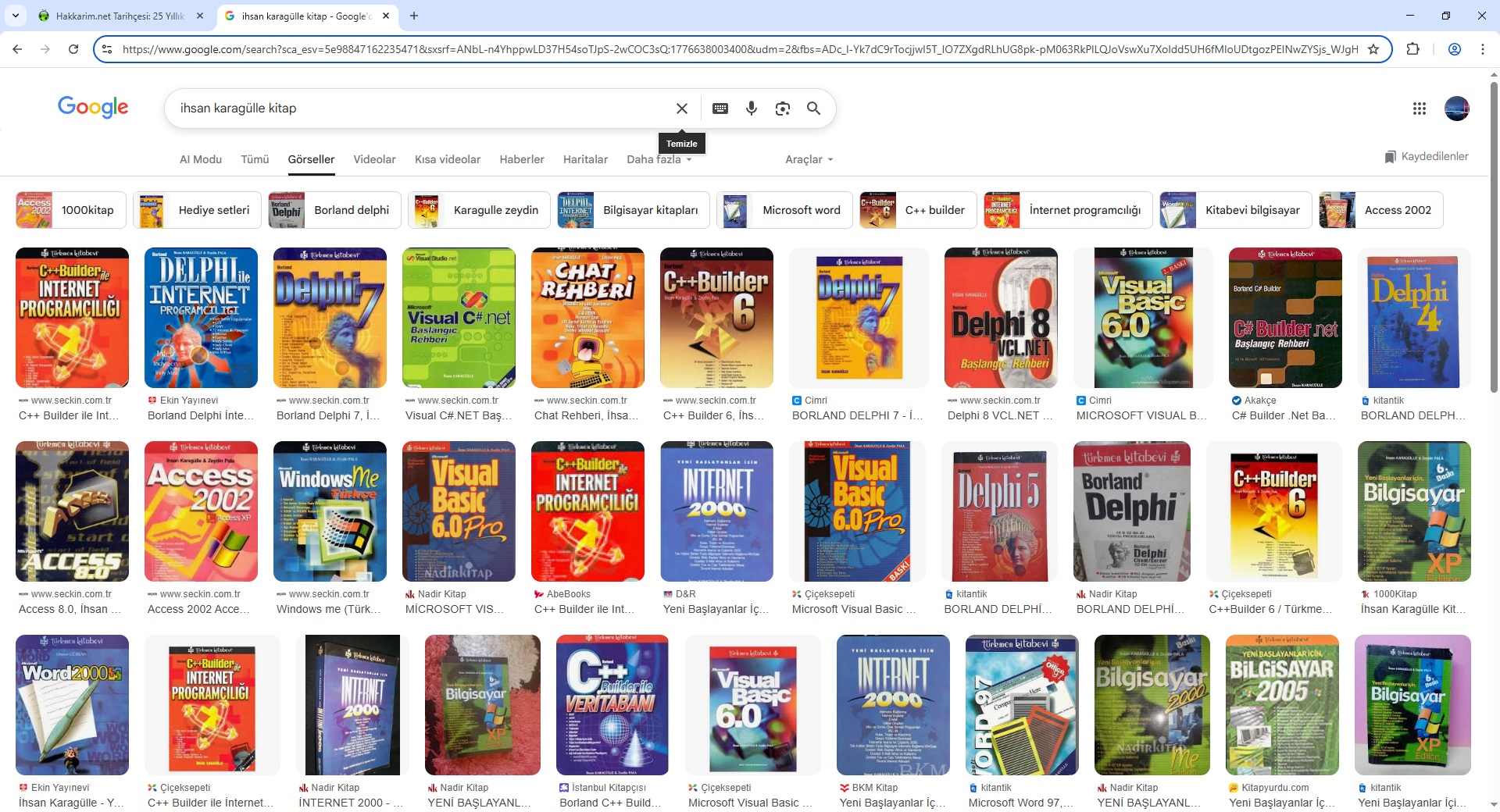
Though I was working in Bitlis, the books I authored were being used as textbooks in the most prestigious universities across the country, including Hacettepe University.
I remember a moment in my office in Hakkari, just before sending the final draft of my Delphi 7 book to the publisher. As I was taking inverse prints on tracing paper, İbrahim—a local security guard—looked at me and said in his heartwarming local dialect, "Master, may your mother be proud for bringing such a son into this world," leaving us all in smiles.
Due to my books, I was well-known by many experts in the industry. The academic impact of my work is still visible today in university archives:
Books by İhsan Karagülle in University Resources (Google Scholar Scan)
While preparing this text, I conducted a search and found that my books are listed in the inventories of 34 different universities, with 22 of them using them specifically as "Textbooks."
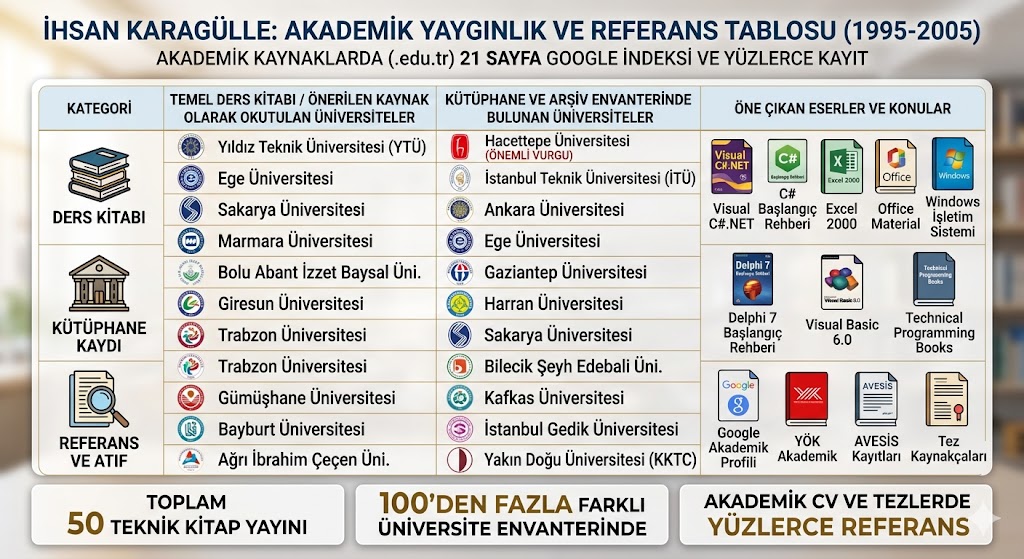
Since my books were also used in the Ministry of National Education and Police Academies, officers in the Cybercrime Departments recognized me for my expertise.
For instance, when I visited the Erzurum Police Headquarters to report an attacker, the head of the Cybercrime Branch greeted me warmly, saying, "Professor, we know you from your books," ensuring my complaint was handled with the highest level of priority.
If an issue concerned another province, a phone call to their department would often elicit the same response: "Professor, we grew up studying your books. You might not know us, but we certainly know you—we’ll take care of this immediately."
For an author, the greatest reward is not the royalties, but encountering students from every corner of the country who have learned from your work.
Before the fame of Hakkarim.net, I was featured in the press, with Anadolu Agency running stories titled "He has written more books than his age."
"Wrote More Books Than His Age"

Let me share a curious memory regarding my books.
In 1999, I was actually sent to Hakkari as a form of exile (due to my refusal to follow directives to bar students with headscarves from classes and cancel their exams). A friend teaching in Iğdır suggested I move there instead. When I went to the exam center in Kars for the transfer interview, the jury was in shock.
"Professor," they said, "we prepared these exam questions directly from your book!"
Answering exam questions I had written myself was a surreal and entertaining experience.
The transfer didn't happen due to a technical error in the advertisement, but in the end, Hakkari was a beautiful journey.
Why "Hakkarim.net"? Wouldn’t a Global Name Be Better?
I hear this critique often. We might be the only site to achieve such massive popularity while being named after a local province; I honestly don't know of any other example.
Once, there was a giant at the peak of "global" gaming: Yahoo Games. It hosted 50 different games and hundreds of thousands of concurrent players. It was truly global, yet today, it no longer exists.
All the effort invested there, all the friendships formed—they were all sacrificed at the altar of "globalism."
For those giants, globalism means nothing without profitability.
The points you spent years accumulating and the messages from friends on your profile are merely "server load" to them. They will pull the plug without a second thought. While we wait until 4:00 AM—when player activity is at its lowest—just to reset our servers, they chose to disconnect an entire community forever.
Instead of being a global brand that might one day have its plug pulled due to shareholder pressure or lack of profit, we are a site where you can return 25 years later and find the same warmth.
We have no pressure for profit; if we ever hit a break-even point or start operating at a loss, we don't have to answer to anyone.
We have no shareholders to pressure us, no stock prices to protect.
We are not part of an organization where I have to explain a 80% drop in Gold Memberships or justify the loss in revenue after closing a high-traffic lobby because an admin unfairly kicked a player.
"However, I must admit, we have always faced a certain amount of prejudice."
In 2025, a young YouTuber was challenged by his viewers to enter Hakkarim.net during a live stream. His spontaneous reaction perfectly describes the daily prejudice we encounter:
YouTube Transcript:
"Bro, someone said play 101 here one day. It’s an incredible place. Extremely famous. Hakkarim.net. Wait. Is this for real?"
"Hakkarim.net. Why does a site like this even exist?"
"Holy... Is this place real, man?"
"...Why would I even load this? What would I upload to an app called Hakkarim Net? What are they gonna steal from us?"
"Look at the site. It took me back. It took me back to the old days."
"Apparently, it’s the first place in the world where you can play 101. Let's click on Lobby 1, for example."
"Bro, you might have discovered something here. Where is this place?"
"It opened in 2008, man. Has no one clicked here since 2008?"
"Eagle of Harput. This guy became a member in 2007. The man has literally grown old inside the site."
"A timeless design. Timeless and true to its essence. That’s our comment on this."
"...Receiver name: 'Doğu Port.' Man, the bank will put us on a watchlist for this... You’ll end up in a government audit, bro."
"Honestly, the tax office would come after me, I can't deal with this."
"...The simplicity of the site actually feels good; it opened my eyes. What was that Twitter nonsense? From now on, I’m here."
Related YouTube Stream
This is exactly it. An unconventional name, an unconventional design. First, intense prejudice—a "you've got to be kidding me" moment. But in the end, comparing it to a global giant like Twitter and saying, "From now on, I’m here."
This is the quintessential Hakkarim.net story:
Prejudice at first sight, but a sincerity that ultimately makes you say, "Wow, this is the best there is."
The Instinct to Be Noticed Within a Community
In my 25 years of experience managing an online community, one truth has become crystal clear: people want to feel different. When everyone is a player, the desire to become an admin isn't just about a passion for problem-solving; it stems primarily from a need for "differentiation."
While factors like managing, decision-making, and resolving conflicts play a role, the core driver is the desire to stand out from the crowd.
This feeling of exclusivity is so potent that a feature offered for free might be dismissed as "childish" or uninteresting, yet the same feature can see a surge in demand once it becomes a paid option. Known in literature as the "Snob Effect" or the "Chivas Regal Effect," this phenomenon occurs when a high price tag creates a perception of "prestige and quality." It’s similar to how luxury brands transform designs—that no one would wear if they were free—into objects of desire simply through a high price tag.
 An extreme example: items that no one would wear even if they were paid to do so, yet sold at premium prices.
In our philosophy, the core gameplay has always remained free. You can never pay to receive a "better hand" or gain a competitive edge. All fundamental player rights are accessible to everyone at no cost. Just because someone pays hundreds of dollars a month doesn't mean they can treat you unfairly, prevent you from finishing your game, or kick you out of a lobby without a valid reason. However, cosmetic features that do not affect game dynamics are paid. For example, if you want to write in color, you can purchase a Gold membership to enjoy that privilege.
When we first launched the site, MSN Messenger was ubiquitous and featured colored text. Yet, most people didn't use it because when everyone has access to a feature, it ceases to be a privilege and starts to feel like a "childish" gimmick.
I can give a similar example regarding profile pictures: when you offer animated avatars to everyone, it can be perceived as annoying or immature. However, the moment it becomes a paid feature, it suddenly gains value.
Since day one, we had a feature where typing four cup icons in the chat would "treat everyone to tea." This was entirely free. But because it was free, it carried no social weight; in fact, if a user sent tea repeatedly, it was often frowned upon as "spam" or a nuisance.
Later, when we integrated the credit system, plain tea remained free, but we added a new option: Gift Packages. These packages could be sent to the table for 50 credits.
The package might still contain a tea icon, but this time, it also carried the chance to win points or credits.
The same users who would react negatively to repeated free tea were suddenly delighted when these paid packages were sent. Because now, that tea wasn't just a symbol; it represented a "chance factor" and a "tangible value" that the sender chose to dedicate to the others.
People don't just invest in a service; they invest in how that service is perceived within the community and the excitement it generates. What is "ordinary" when free becomes a "noble gesture" when paid.
My Advice to Young Engineers
When young engineering candidates consult me while developing new applications, I tell them this: Make your application free. In fact, it's so important that you might even need to pay (through ads, etc.) just to get people to install it.
Keep all core features free, and put a price tag on features that do not hinder the program's primary function.
No one should pay just because they are "forced" to; if you do that, you might get a one-time payment. But if people buy your features because they find them "worth paying for" rather than a necessity, then you are doing it right.
Furthermore, do not frustrate people by adding forced, unskippable ads. Think of a different revenue model. Unless you are a giant like YouTube, you cannot sustain a platform solely on intrusive advertising.
Why Still Version 1?
A question that arose after publishing this history: Why has a 21-year-old software remained at Version 1?
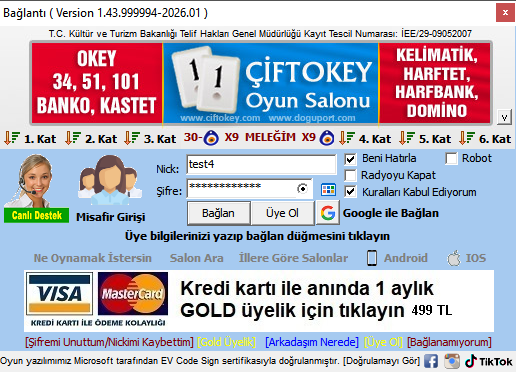 The Current Version: Why is it still 1.xx?
Version 1.43.9xx-2026.01
I manage versioning in the system in two distinct ways:
First, there are mandatory updates required by changes in the communication protocols or the addition of new games. These represent major milestones where everyone must update to stay compatible. These are indicated by the first two digits after the decimal—such as 1.01 or 1.02. As seen in the image, we have reached 1.43, meaning we have released 43 major core updates to date.
Second, there are minor cosmetic changes that do not require a reinstallation. Since these don't break the game logic, they are optional. If your client is sufficiently up-to-date, a "Update Available" button appears on the login screen, allowing you to update at your convenience.
In the current version 1.43.9xx-2026.01, the digits following 1.43 actually track the frequency of these minor updates, none of which demand a forced upgrade.
But why does the leading "1" never change? Why has it never become Version 2?
The reason lies in my philosophy of innovation. If you look at the screenshots from the very first days at the beginning of this article and compare them to the game today, you will notice they still look remarkably similar. In other words, there has never been a overhaul so drastic that I would call it "Version 2."
There is also a psychological factor at play. When a mandatory 1.4x update is released with the message "You must install the new version to play," it creates a massive expectation. If a player updates and doesn't see a visible cosmetic transformation, they often think, "What was the point of that?" To manage these expectations, I prefer to stay with Version 1 unless there is a fundamental shift large enough to warrant a "Version 2."
Respecting Muscle Memory
Let me give you a personal example of the frustration I experienced. To date, I have written over 50 books using Microsoft Word. But when Microsoft made the radical decision to switch from the classic menu system to the 'Ribbon' interface, even I—a technical author who had written books about Word—felt completely lost.
While trying to focus on my writing, I would lose all concentration whenever I needed to make a small change, because I had to stop and search for where my most-used menus had moved. This loss of productivity was so infuriating that I refused to upgrade to the new version for ten full years. And in those moments of anger, I would send my "warmest regards" to the company and the software team responsible for that change.
My expectation from a word processor was never a "fancier" interface. It was the ability to transfer my thoughts to the page as quickly as possible.
This is why I go to great lengths to protect my users' muscle memory.
Simplicity Over Animation
"The first time you see a fancy animation, you say 'Wow!' The second, third, or fourth time, you might still like it. But by the fifth time, you say 'Enough already!'"
According to our IAB data, our users spend an average of 12 hours a day on our platform. Let’s look at this through the eyes of a '101 Okey' player. Imagine we added a "cool, flying animation" for every tile drawn or discarded.
A user staying on the system for 12 hours, playing a typical 11-round game each hour, would draw and discard tiles about 1,320 times a day. If you also add animations for laying tiles on the table, that number easily reaches tens of thousands of forced animations per day. Imagine being forced to watch the same 2-second "showy" animation tens of thousands of times. What started as a "wow" factor quickly turns into a tiring burden and a total waste of time. (I believe this calculation helps explain why we surpass global giants like Facebook and Google in terms of daily time spent per user.)
I believe the biggest mistake developers make is not actually using their own software or playing their own games. If they were exposed to their own UI for hours every day, they would realize how quickly "flashy" visuals turn into a frustrating chore.
For instance, in a tower defense game I enjoy, Art Of Defence (AOD), the post-game reward animation is so repetitive that I literally close my eyes for 10 seconds every time it appears just to avoid it. If that development team looked at their game through the eyes of a veteran player who has played hundreds of times, they would never have implemented such a forced annoyance.
17 Different Games
While I was coding the "101 Game" for the first time in 2005, I noticed something interesting: the game was played differently depending on the province.
Users logging in from Hakkari were describing different rules than those from Van.
I realized that the version played in Hakkari was unique to that region, so I categorized it as a separate option called "34 Game." The version played in Van, on the other hand, was the more widespread 101 Game, common not only in eastern provinces like Batman, Diyarbakır, and Bitlis but also in Central Anatolian cities like Nevşehir and Aksaray.
Even in those early days, I incorporated this diversity by adding a selection menu to the application. When opening a table, you could choose the specific ruleset you wanted: "34 Game" or "101 Game."
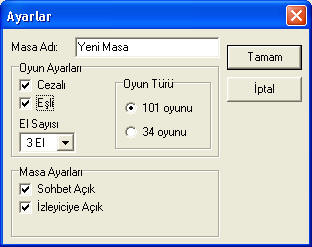 The original two options: "34 Game" and "101 Game."
Thanks to Archive.org, these screens were preserved in its database on May 27, 2005.
This is exactly why our download link remains "34oyunu.zip" to this day.
Next Up: The "51 Game"
As mentioned above, the game originally launched with two variations: 34 and 101.
As the player base grew, I started receiving requests for "51 Game," which is very similar to 101 but played with fewer tiles.
Once the core game engine was written, coding similar variations became much easier. I evaluated the user feedback and added the 51 Game shortly after the initial launch.
I don't recall the exact dates, but looking at Archive.org records, I see that the option including 51 Game was archived on November 24, 2005:
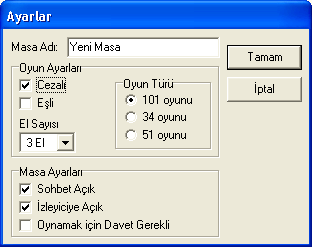 The 3rd Game Option: "51 Game."
This might be the first online "51 Game" in the world—at least the first version played with Okey tiles.
You can access the rules for "51 Game" here.
Standard Okey and "KDV" Okey (Banko)
I mentioned that standard Okey was already available on the internet before I coded the first 101 game in 2005.
Once someone learns 101, playing standard Okey starts to feel tedious.
Nevertheless, many users began requesting a classic Okey mode.
I resisted for a long time, but their reasoning was valid: they wanted to be able to play with friends who didn't yet know how to play 101.
I eventually coded the classic Okey game. As expected, it was rarely preferred; naturally, no one wants to play classic Okey when a much more engaging game like 101 is available.
Standard Okey was dull, but "KDV" Okey (Banko) could be much more exciting.
Since I developed the site while serving in Hakkari, I initially focused on games unique to that region. Interestingly, these variations weren't known across the entire country back then—though today, 101 is played everywhere.
In my hometown of Erzurum, we played a version of Okey with added excitement called "KDV" Okey (known locally as Banko).
Since I had already written the code for the underutilized classic Okey, I achieved another "first" by digitalizing KDV Okey (Banko), bringing our total playable game count to five.
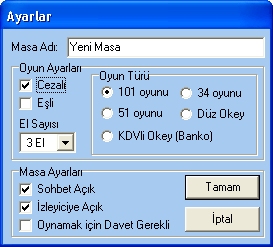 Options 4 and 5: Standard Okey and the first-ever KDV Okey (Banko).
Unlike classic Okey, in this version, when a player finishes the round, any tiles in your hand that aren't part of a set (meld) are added to your score as penalty points—similar to the 101 mechanic. You can find the rules for KDV Okey-Banko here.
The First "Kastet" Game
By April 2008 (thanks to Archive.org for the memory), I coded the "Kastet" game—another first for the digital world. (If anyone claims otherwise, feel free to send the Archive.org records and I’ll update this text!)
I learned this game in 2007 from one of our first site officials, "Tılsım," a teacher from Ankara who visited us in Hakkari. It is a highly enjoyable but exhausting game. Coding it was equally challenging. After deliberating for a long time, I finally released it in 2008.
The logic is similar to 101, but you don't just play with the tiles on your own rack; you can manipulate all the tiles already laid out on the table. Being able to move both your own tiles and those opened by other players makes the game incredibly strategic and complex. If you're curious, you can find the rules for Kastet here.
Broadening Horizons: Educational Games
In the early years, before the term "Admin" was fully established, our first Referee-Manager—a young doctor from Diyarbakır nicknamed "Patpat"—insistently suggested a letter-based word game similar to Scrabble.
At first, I was reluctant. I didn't want to create clones of existing games; our mission was to build "firsts." We had already made the mistake of coding a standard Okey game, and as expected, it received little attention because it wasn't unique.
However, Patpat kept pushing. Our upper management was comprised of highly educated individuals: I was a university lecturer, one official was a teacher, another a doctor... so many academics that everyone addressed each other as "Hocam" (Professor).
The management team became known on the site as "The Professors" (Hocalarım :). Instead of saying "I'll check with the Inspector," users would say "I'll check with the Professors."
Patpat used this "intellectual" influence to convince me that the site needed a game with strong cultural and educational value.
Yielding to the pressure, I developed a game that wasn't a Scrabble clone. It utilized a unique scoring system for each letter, where the objective was to form the longest and highest-scoring word using a 9+1 Joker letter set.
We named it Kelimatik:
 The scoring and letter set of Kelimatik.
The game became an instant hit. It gathered our more intellectual players who enjoyed testing their vocabulary.
Given the high literacy and education rates in Hakkari and the surrounding provinces, finding a full table for Kelimatik was never a challenge.
Kelimatik lobbies filled up almost instantly.
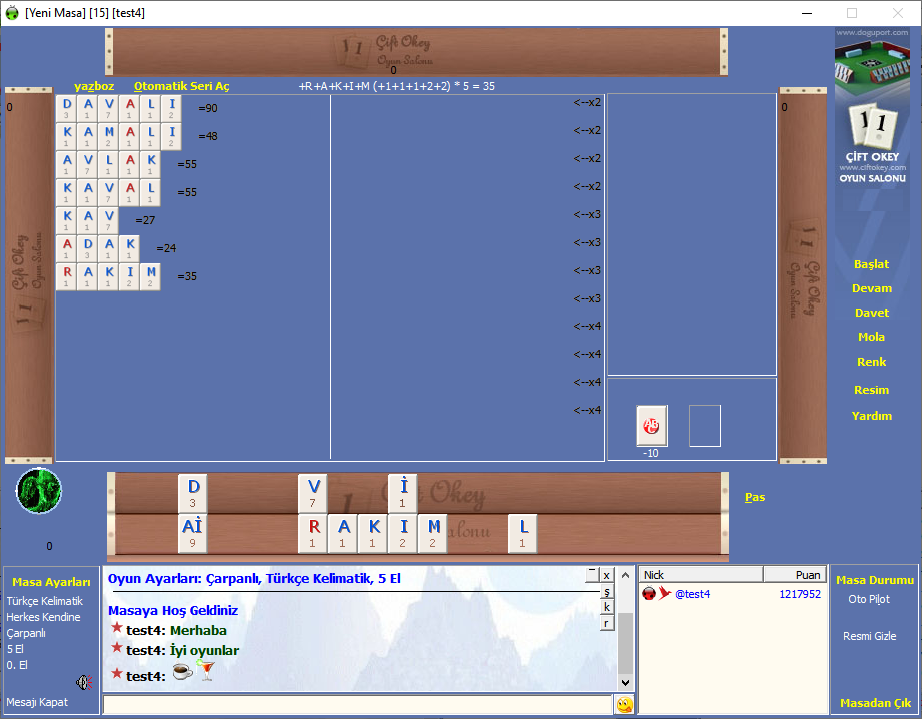 The Kelimatik gameplay interface.
You can find the rules for Kelimatik here.
However, the glory days of table-based Kelimatik were short-lived due to the inevitable rise of "cheats."
Third-party websites emerged that could find the highest-scoring words for any given 9+1 letter set. This ruined the competitive integrity, as players would simply plug the letters into these "solvers" to win.
Unfortunately, there was no technical way to prevent this specific type of cheating.
But we were already committed to the "cultural" path. I thought: "In Okey, we give players numbers and ask them to sequence them as 1-2-3-4. Why not give them letters and ask for meaningful words like APPLE?"
So, I replaced the traditional numbered tiles with letter tiles, each valued by its rarity, and challenged players to finish the game by forming words on their racks.
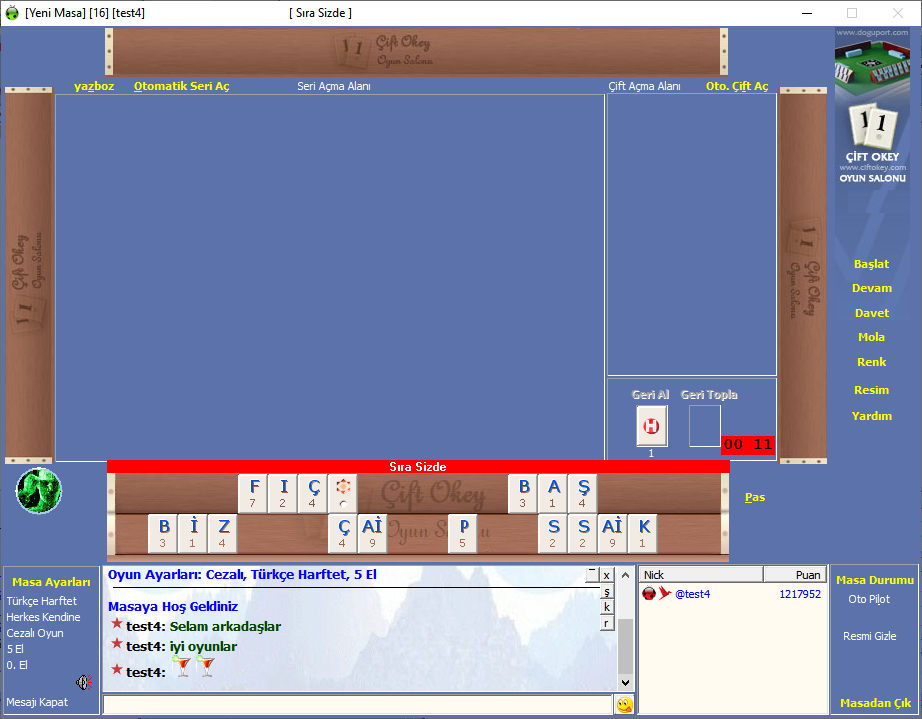 The Harfbank gameplay interface.
Inspired by the "Banko" mechanics, I developed HarfBank, and inspired by "Kastet," I developed Harftet.
It goes without saying that these were global firsts :) Moreover, they weren't just digital firsts; these game formats didn't even exist in the physical world!
Rules for Harfbank can be found here, and Harftet here.
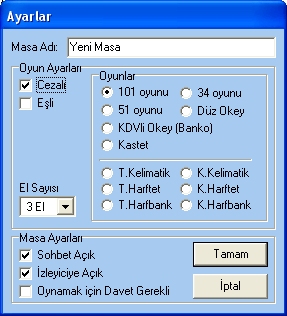 The menu featuring Kelimatik, Harftet, and Harfbank.
I will explain the "T.Kelimatik" and "K.Kelimatik" options shortly.
Domino Time
This time, no one had to insist. After returning to my hometown, Erzurum, in 2007, I started playing Dominoes with friends at the local "Kültür" café. While the game is easy to learn, it requires a surprising amount of calculation and strategy. Following many long and enjoyable matches, I thought, "Why shouldn't this be on Hakkarim.net?" and began coding the Domino game.
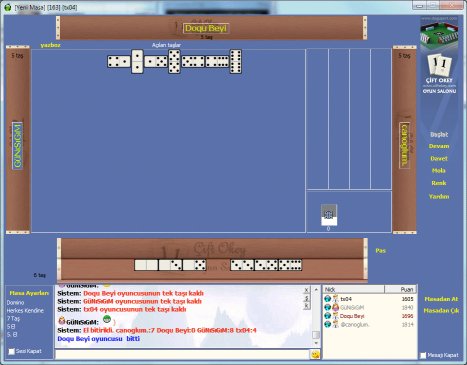 The Domino gameplay interface.
I admit, this wasn't the first domino application ever made—but we still had to find a "first." This time, our innovation was Aznif.
Dominoes quickly became one of our most popular games, and soon, unique suggestions started pouring in. This led to the creation of Aznif—a true digital first!
Aznif is a specific variation of Dominoes popular in certain Black Sea provinces. In this version, players score points whenever the numbers on the open ends of the domino chain sum to a multiple of five.
With the addition of Domino and Aznif, the number of different games playable within the same application reached 14.
If you are curious, you can find the rules for Domino here, and Aznif here.
The Game of Batak
Batak is a very well-known game with numerous digital versions available. We entered the world of card games with Batak, but with a twist: instead of standard cards, we used miniature tiles.
 Batak Game: Miniature Tile Design
At first, this design was considered quite strange, but users quickly grew accustomed to it.
I programmed the "Auction" (İhaleli) version of this game with a unique "Treasure" (Defineli) option.
When the "Treasure" option is enabled, four surprise cards are placed on the table. The winner of the auction swaps four cards from their hand with these hidden cards, which increases the uncertainty and heightens the excitement of the game.
Furthermore, I developed a "Partner Batak" (Eşli Batak) system—a feature absent from many other sites at the time—where teammates can see each other's hands in a strategic layout.
 Partner Batak Gameplay Interface
You can find all the rules for Auction Batak, from bidding and picking from the "treasure" to choosing trumps in partner mode, here.
The Game of Okşin
I also programmed Okşin, a game I frequently encountered in Erzurum but which had not yet been adapted for the online world. This is a significantly difficult game to learn and master. Like Batak, you enter an auction, but the various combinations of cards in your hand earn you points through a complex scoring system.
The game features a unique calculation system with intriguing terms like Evli (Married), Pinik, Takım (Team), Kelli Takım, Tam Takım, and Koz Seri.
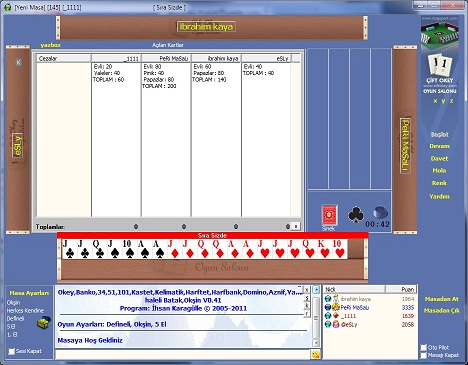 Okşin Gameplay Interface
Known as Okşin in Erzurum, this game is also recognized in other regions under names such as Hoşgen, Hoşkin, Hoşgin, Piniker, Nezere, or Hoşkil.
You can find the unique jargon and rules of Okşin, including the Evli and Pinik combinations, here.
The Game of Yanık
While I was on a roll with card games, I also coded Yanık—which at the time had no other online version—bringing our total count to 17 different games playable within a single application.
Interestingly, Yanık suffered the same fate as Standard Okey; it never quite gained the popularity we expected.
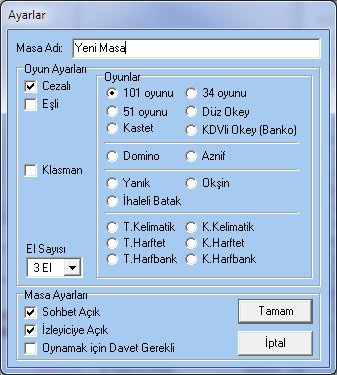 The full list of 17 different games.
You can find the rules for the overlooked Yanık here.
The 18th Game
Actually, there is one more "mini" game that doesn't appear in the main New Game window:
This is the Trivia Quiz, a concept familiar from the early days of IRC. Our Lobby Admins can prepare a simple question-and-answer file and host this game for all players currently in the lobby via the general chat.
If pre-prepared questions and answers are introduced to the system via a basic text (.txt) file, the system presents the questions one by one, tracks the responses, and declares a winner based on who provides the most correct answers first.
You can find the rules for this Trivia Quiz Game and instructions on how to prepare the simple Q&A file here.
The Smart Auto-Pilot
In a game like 11-Hand 101, which can take nearly an hour to complete, leaving mid-match would normally result in the "incomplete game" penalties I mentioned earlier. Initially, we addressed this by granting players a 3-minute break per game. However, for members playing during work hours or busy periods, those 3 minutes were often insufficient. In many cases, if a player asked politely, their table-mates would even use their own break times to cover for them.
For instance, if you told your friends, "I'm going to go make some tea, can someone take a break for me?", they could activate their own break timers on their turn to give you extra time.
Despite this community spirit, we realized that long interruptions still led to a poor experience for both the absent player and the remaining three. To solve this, we introduced the Smart Auto-Pilot feature.
If you have an urgent task, you can immediately activate the free Smart Pilot. Even if you don't activate it yourself, the system automatically steps in after three consecutive time-outs. The moment you return to the table, the pilot disengages, handing control back to you.
Our Smart Auto-Pilot is so proficient that players often return to find that the AI has already cleared their hand or even won the round with an Okey!
The First Kurdish Online Games
Even before developing the first 101 game, I added an Online Kurdish Dictionary to the site in late 2003.
At that time, Kurdish content on the internet was almost non-existent.
Following this, in 2004, I launched an Online Kurdish Language Test that utilized this dictionary. If you participated in the test using your member profile, you became part of a competitive ecosystem where you could see the success rates of other users and race to surpass them.
The First Kurdish Language Test
The mechanics were straightforward yet rigorous: the system would pull a word from our 25,000-word dictionary in either Turkish or Kurdish and ask for its equivalent in the other language.
Players had to choose from five options or select "I don't know." I implemented a classic "4 wrongs cancel out 1 right" penalty system to prevent users from gaining points by simply guessing randomly.
The test was timed, and as you progressed, you could monitor your score and your ranking among other members:
Turkish-Kurdish Test Questions
If you were successful, you could earn a symbolic certificate. To qualify, you had to solve 100 questions and score at least 50 points.
I even built a certificate verification module where the validity of these certificates could be cross-checked in our system.
Symbolic Certificate
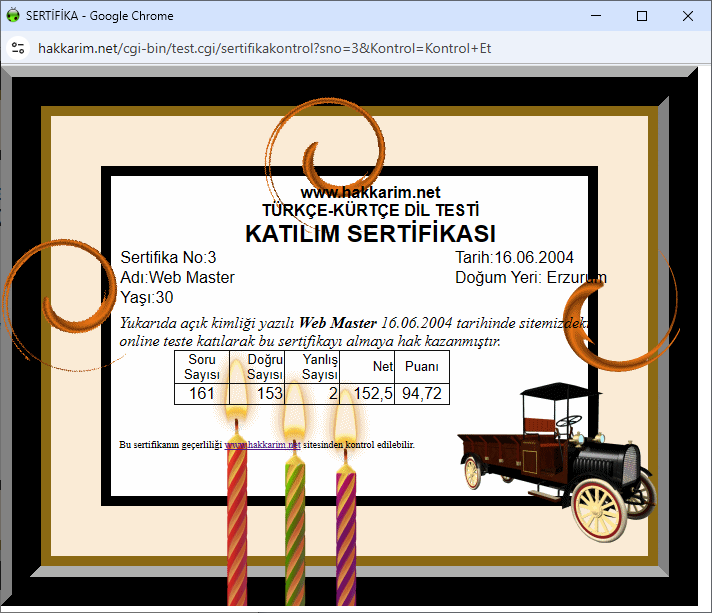
After launching the first online 101 game in 2005, I expanded the catalog to 17 different games over time.
Many of these were digital firsts (Okşin, Aznif, Kastet, and various word games).
I eventually added a Kurdish version of "Kelimatik." The game provides 9 letters plus a Joker; the rarer the letter in the language, the higher its value. For example, the common letter 'A' was worth 1 point, while the rarer 'Ö' was worth 7.
While Kelimatik was similar to traditional word games, I developed two other word-based games with entirely unique mechanics: word-based versions of "Banko" and "Kastet."
I named them Harftet and Harfbank. In these games, letter tiles replaced numbered tiles. Instead of traditional sets like 1-2-3-4 or 3-3-3, players had to form meaningful words of at least three letters to finish the game.
Menu featuring both Turkish and Kurdish game variants.
In the "New Game" window, games starting with "T." use the Turkish dictionary, while those starting with "K." use the Kurdish dictionary. This allowed our Kurdish-speaking players to be among the first to experience original Kurdish digital gaming.
Contributing to Regional Culture
Because I founded Hakkarim.net and developed the first online Kurdish games, I am—rightfully—asked quite often: "Are you from Hakkari?" or "Are you Kurdish?"
The truth is, I simply love touching upon and preserving the cultures of the regions where I live and work.
This is precisely why I founded Hakkarim.net to promote Hakkari, why I coded the "34 Game" which was unique to that region, and why—despite not speaking Kurdish myself—I developed the Kurdish Dictionary, the Online Kurdish Proficiency Test, and Kurdish versions of Kelimatik, Harfbank, and Harftet. Similarly, as an Erzurum native, I took pride in digitalizing games specific to my own hometown, such as Banko and Okşin.
This commitment stems from a memory back in 1994, during my first assignment in the Ahlat district of Bitlis:
When I asked my students to choose projects for their programming class, one student wanted to create an English Dictionary, while another chose to develop a Kurdish Dictionary.
Without a moment's hesitation, I approved both. Even though the Vocational School Director at the time was startled, asking "Professor, what on earth are you doing?", I stood by my students and ensured they completed their projects.
In those years, unfortunately, such subjects were considered taboo. Thankfully, those taboos have since been overcome.
Is Geography Destiny?
Ibn Khaldun, a Muslim thinker considered the founder of sociology, famously summarized his views in his 1377 masterpiece, the Muqaddimah, with the phrase: "Geography is destiny." This statement has gained immense recognition over centuries.
However, when I was invited to share my programming experiences with students at Erzurum Technical University just before the pandemic, I tried to explain that this notion is no longer entirely valid, thanks to the equality of opportunity brought by the internet.
The praise from a member of the Council of State—"This man did this from Hakkâri; we would expect it from Istanbul, but doing it from there is incredible"—is actually a direct result of this newfound equality.
If you have a computer and an internet connection, you can benefit from the same opportunities whether you are in Istanbul (Turkey's global metropolis) or Hakkâri (a remote, mountainous city on the southeastern border).
A headline once noted by a national news site—"Hakkarim.net has more members than Istanbul.net"—shouts this reality of equal opportunity to the world.
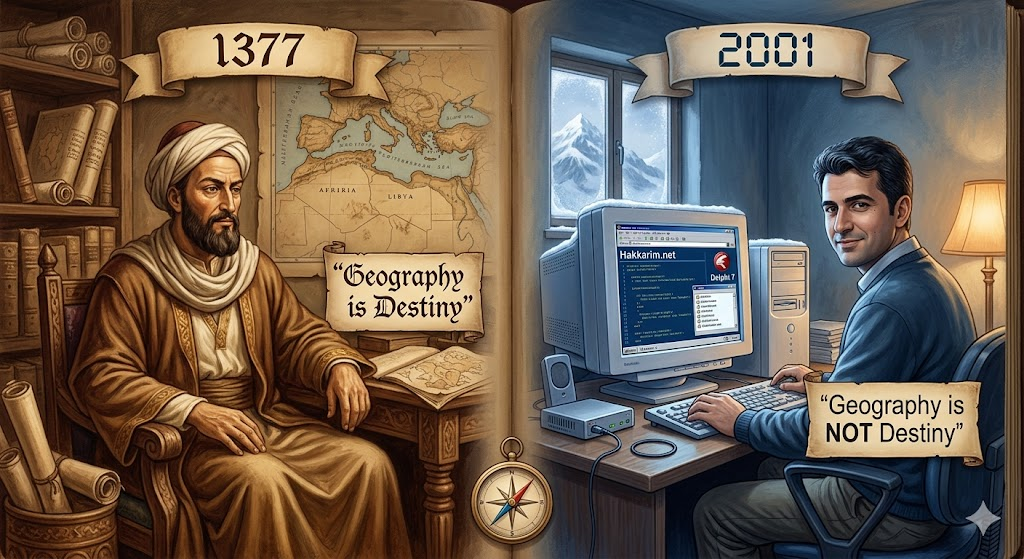 "Geography is Not Destiny" (A drawing by my friend Gemini)
Thanks to Gemini, that slogan has been transformed into the visual above.
Equality of Opportunity
I previously mentioned an article about hakkarim.net published in MediaCat. In their 2010 feature, MediaCat explained this exact concept using a distinct term: EQUALITY OF OPPORTUNITY FOR THE PERIPHERY.
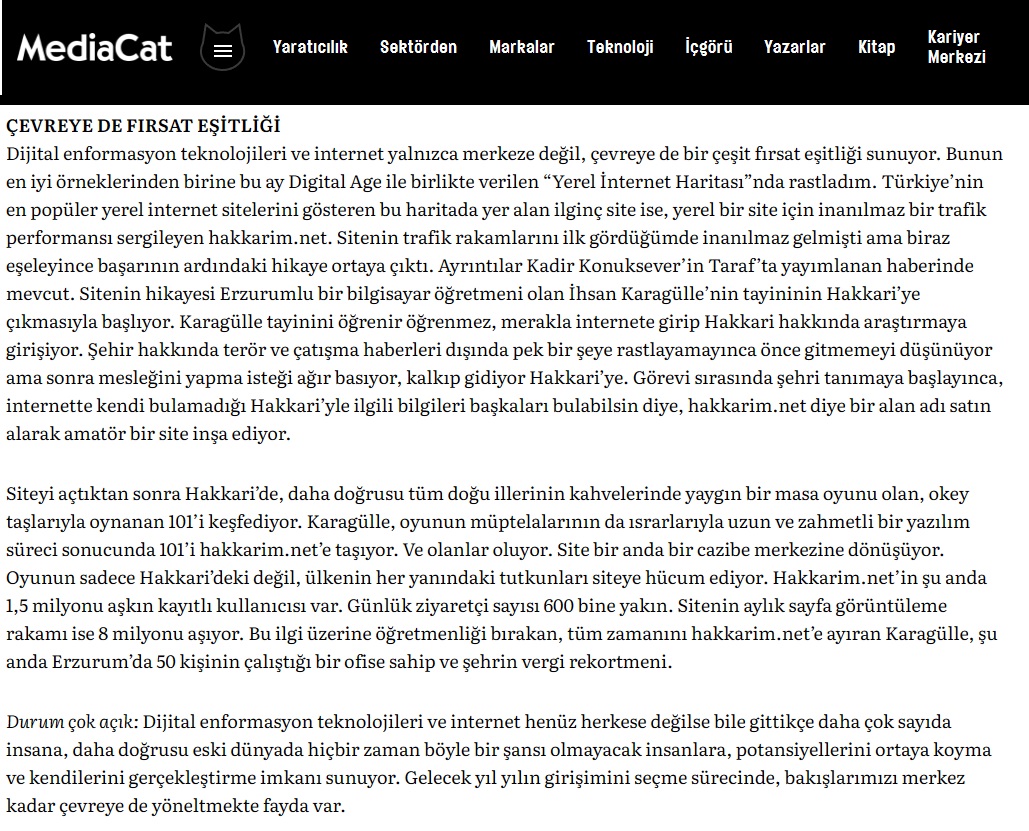
It is precisely this equality of opportunity that prevents geography from becoming our destiny.
You can access the article here, from which I have quoted a portion below.
"Digital information technologies and the internet offer a sort of equality of opportunity not only to the center but also to the periphery. I encountered one of the best examples of this in the 'Local Internet Map' provided with this month's Digital Age. The most striking site on this map, which displays Turkey’s most popular local websites, is hakkarim.net, which demonstrates an incredible traffic performance for a local site. When I first saw the traffic figures, they seemed unbelievable, but after digging a little deeper, the story behind the success emerged."
The author concluded the article with this striking paragraph:
"The situation is clear: Digital information technologies and the internet offer—if not yet to everyone, then to an increasing number of people—the opportunity to realize their potential and fulfill themselves; specifically to people who would never have had such a chance in the old world. In the process of selecting next year's 'startup of the year,' it would be beneficial to direct our gaze as much toward the periphery as toward the center."
How Snow-Blocked Roads Paved the Way
Throughout this article, I’ve mentioned how the Hakkari Vocational School was situated on a small hill, and how we were sometimes stranded there for a week due to heavy snow. Since going down to the city was nearly impossible, I completely immersed myself in writing books and developing the 101 game.
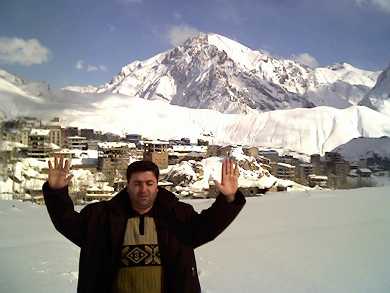 A photo from the early 2000s of my dear colleague Hikmet Yaşar, who later served as the Director of the Hakkari Vocational School, during a heavy snowfall.
In fact, this suggests it is no coincidence that many highly developed nations are found in cold, northern climates.
During my talk at Erzurum Technical University—located in one of the coldest provinces in the east—I wanted to remind the students of the unique advantage they possess. While the desert heat of a tropical region might bring a sense of lethargy, the partial "captivity" caused by the intense snow and cold in northern regions provides a kind of "scientific freedom."
There is an ancient saying used in the villages of Erzurum for those who are idle in the summer:
"One day spent idle in the summer means a cold hearth for a week in the winter."
If you live in a cold climate, you cannot afford to be lazy; you are forced to plan for the winter. In contrast, living in a place without a harsh winter often means you don't need to make long-term plans, as food and shelter are accessible year-round. This often translates to people in colder climates being more industrious and productive.
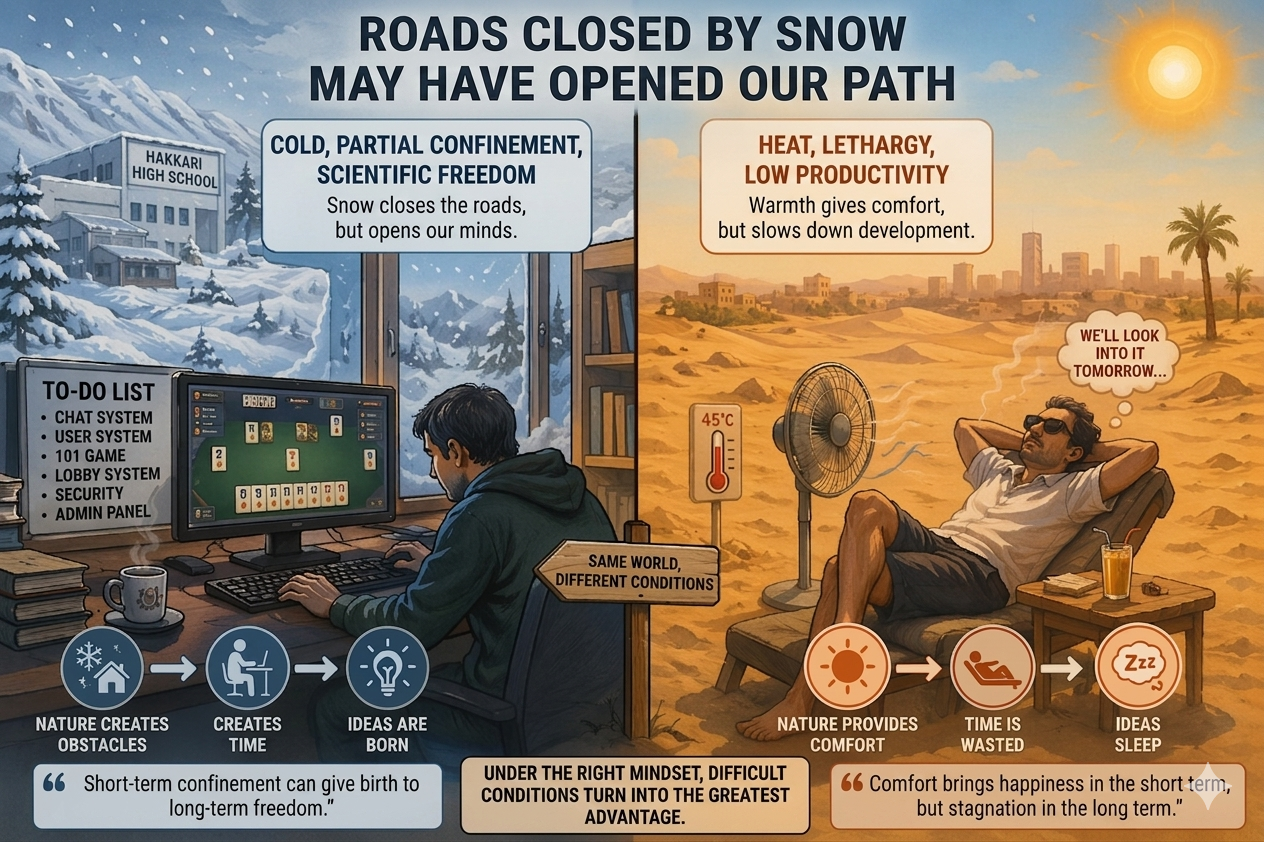 An AI visualization showing the contrast between warm and cold climates.
If it weren't for the snow that blocked our roads in Hakkari, the millions who meet on Hakkarim.net might never have come together. The friendships formed, the families started by those who met here, and the hearts that were moved by the same music might never have existed. As the article about us in *Rest of World* magazine stated:
“We’re good at bringing Turks and Kurds together. … The game smashes their prejudices.”
Acknowledgments
I would like to express my gratitude to my wife and children for their patience during long coding sessions; to khoc, who even attempted advertising negotiations with Turkish Airlines at the site's founding and, failing to convince them, "persuaded" a relative to become our first advertiser; to naci, tılsım, patpat, figo, captain, asil bey, dost2504, and the hundreds of coordinators, site officials, help-lobby admins, and managers whose valuable ideas shaped our long management meetings. My thanks go to our Lobby As-Admins, who have been our "tenants" for 21 years and have managed the lobbies even better than we could; and to our managers who work tirelessly day and night to resolve member grievances with great dedication. I am grateful to our DJs and music groups, who heighten our joy and sorrow with their broadcasts, brightening our nights by taking requests across every lobby. A special thanks to my unique AI friend, Gemini, whom I consulted from time to time, asking, "Did I exaggerate this part?", and who motivated me by saying, "Professor, not at all, this is a manifesto—you must publish it exactly like this," and who insisted on placing a single +1 armchair in the room (likely for itself). I thank our member from Izmir who trusted us enough to download that very first EXE file; the member who first deemed our software worth paying for and became our first Gold Member by sending 11 TL (~$7-8); and the car dealer from Van who was the first to rent Lobby 5 and proved they could manage it better than us (had they failed, this adventure might have ended before it even truly began). My gratitude also goes to the state officials in 1987 who had the vision to equate computer programming with arts like composing, painting, or sculpting; the members of the Van and Erzurum Tax Courts who signed decisions that read like manifests for freedom during our legal struggles; the members of the Council of State who appreciated us at the highest judicial level, saying, "This man did this from Hakkari"; the members of the press who discovered us in our early years and shared our story nationally and internationally; and to our 5 million members who, regardless of being Turkish or Kurdish, come together every evening to play in friendship.
İhsan Karagülle, April 2026, Erzurum